
Ladle vs Ladel is a common spelling mistake in English spelling, especially for learners who rely on pronunciation when writing. The correct spelling is ladle, a kitchen tool used to serve soup or scoop liquid. It can function as a noun or a verb, depending on its word usage. For example, a chef ladles out bowls of harira, a thick soup containing beans, herbs, and spices. Here,
ladles is the present tense, third-person singular form describing the chef’s action during food preparation, cooking, and serving food. The incorrect form, ladel, is a common misspelling linked to pronunciation-based spelling errors, the spoken form, and confusion about vowel order or vowel
placement. Although the extra vowel may seem reasonable when the word is spoken, the forms are not interchangeable forms. Remembering the standard English spelling improves spelling accuracy, writing accuracy, English vocabulary, English grammar, and written communication in academic writing and everyday writing.
From a linguistic analysis perspective, this difference can be discussed through synchronic analysis, the study of a language’s present state at a particular point in time or period in time. This viewpoint of analysis focuses on language structure, word meaning, and phrase meaning, rather than historical language change or etymology. By contrast, diachrony, diachronic analysis, and historical linguistics examine language development and etymological history, including the true etymological derivation
of a word or phrase. A purely synchronic analysis may consider a language speaker’s intuition, while a surface analysis can differ from a word’s history. For practical language learning, however, applying spelling rules and grammar rules is more useful than guessing from a vowel sound. For example, “Please
ladle the soup into the serving bowls” is an English sentence showing correct English usage. These real contexts connect spoken language, word formation, culinary vocabulary, and cooking terminology with writing skills, language study, and clear everyday communication and academic communication.
What Is the Difference Between Ladle and Ladel?
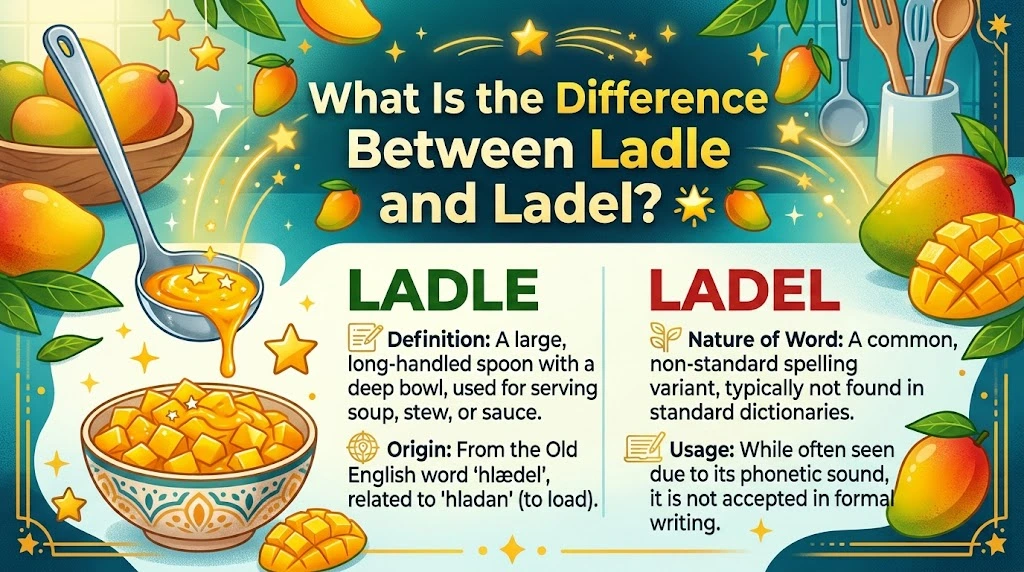
The main difference is simple: ladle is the correct English word, while ladel is an incorrect spelling.
| Word | Correct? | Meaning |
| Ladle | ✅ Yes | A large, deep spoon used for serving liquids |
| Ladel | ❌ No | A common misspelling of ladle |
A ladle is usually used in the kitchen. It has a deep bowl and a long handle, making it easy to serve soup, stew, gravy, punch, or sauce.
Example:
- Please use a ladle to serve the soup.
What Does Ladle Mean?
The word ladle can be used as both a noun and a verb.
As a noun, a ladle is a large spoon with a deep bowl and a long handle.
Example:
- She picked up a ladle and served the soup.
As a verb, ladle means to serve or transfer a liquid or soft food using a ladle.
Example:
- He ladled soup into the bowls.
Therefore, ladle has both a useful everyday noun meaning and a related verb meaning.
How Do You Use Ladle in a Sentence?
The basic sentence structure depends on whether ladle is being used as a noun or a verb.
Ladle as a Noun
A simple pattern is:
Subject + verb + ladle
Examples:
- I washed the ladle.
- She bought a new ladle.
- The ladle is in the kitchen.
- Please pass me the ladle.
Ladle as a Verb
The common pattern is:
Subject + ladle + object + place
Examples:
- She ladled soup into the bowl.
- He ladled gravy onto the potatoes.
- They ladled stew into large containers.
These examples show how nouns and verbs work differently in English sentence structure.
Read More;Soo vs So: Which Is Correct? Meaning, Usage, Examples, and Grammar Rules
Why Is Ladel Incorrect?
Ladel is usually created because English spelling can be difficult. Learners may hear the word ladle and assume that it should be written as ladel.
However, standard English spelling is ladle.
The final letters -le are important. The correct spelling is:
L-A-D-L-E
Not:
L-A-D-E-L
A Simple Spelling Tip
Think of ladle as having the word ending -dle:
- ladle
- candle
- handle
- bundle
This can help you remember the correct spelling.
Ladle Examples in Everyday English
Here are several natural examples using ladle:
- Please pass the ladle.
- She used a ladle to serve the soup.
- The ladle is hanging beside the stove.
- He bought a wooden ladle for the kitchen.
- Use a clean ladle for the sauce.
- Mom filled the bowl with a ladle.
- The chef picked up the ladle.
- She stirred the soup with a ladle.
- He ladled gravy over the meat.
- They ladled the stew into bowls.
These examples demonstrate the word in different everyday contexts.
Ladle as a Verb: Forms and Usage
Because ladle can also be a verb, it has different forms according to tenses.
| Tense | Verb Form | Example |
| Present | ladle | I ladle soup into bowls. |
| Third person | ladles | She ladles soup into bowls. |
| Past | ladled | He ladled soup into the bowl. |
| Present participle | ladling | They are ladling soup. |
| Past participle | ladled | She has ladled the soup. |
Notice that the past form is ladled, not ladel or ladled with a different spelling.
The verb follows normal English spelling patterns when endings are added.
Ladle and English Tenses
The word ladle can appear naturally in different tenses.
Present Simple
- I ladle soup every evening.
- She ladles gravy onto the food.
Past Simple
- He ladled soup into the bowls.
- They ladled the stew into containers.
Present Continuous
- She is ladling soup into the bowls.
- They are ladling sauce onto the plates.
Present Perfect
- He has ladled the soup already.
- She has ladled enough gravy for everyone.
Future Simple
- I will ladle the soup into the bowls.
- She will ladle the sauce over the vegetables.
Just as you may study future indefinite tense examples, learning verb forms such as ladle, ladled, and ladling helps you understand how tenses change the form and meaning of verbs.
Common Mistakes With Ladle
English learners often make spelling and grammar mistakes with this word.
Mistake 1: Writing Ladel
❌ She used a ladel to serve soup.
✅ She used a ladle to serve soup.
Mistake 2: Using Ladle as a Plural
The plural form is ladles.
❌ There are two ladle in the kitchen.
✅ There are two ladles in the kitchen.
Mistake 3: Confusing the Noun and Verb
Compare:
- The ladle is on the table. — noun
- She ladled soup into the bowl. — verb
Understanding the grammatical role of a word makes sentence construction easier.
Ladle vs Ladel Comparison Table
The following table provides a quick comparison.
| Feature | Ladle | Ladel |
| Standard spelling | ✅ Correct | ❌ Incorrect |
| Part of speech | Noun and verb | Not standard |
| Meaning | Serving spoon; to serve with a ladle | No standard meaning |
| Plural | Ladles | — |
| Past tense | Ladled | — |
| Present participle | Ladling | — |
| Example | She used a ladle. | She used a ladel. ❌ |
So, whenever you mean the large spoon used for serving liquids, choose ladle.
Ladle, Verbs, Clauses, and Sentence Patterns
Because ladle can function as both a noun and a verb, it can appear in different clauses.
Noun Clause Pattern
A simple sentence can use ladle as the object:
- She washed the ladle before dinner.
Here, ladle is the object of the verb washed.
Verb Pattern
When ladle functions as a verb, it can take an object:
- She ladled soup into the bowls.
The basic pattern is:
Subject + verb + object + prepositional phrase
The word soup is the object, while into the bowls explains where the soup was placed.
This type of sentence pattern is useful when learning clauses, verbs, objects, and other parts of English grammar.
Ladle in Questions and Negative Sentences
You can also use ladle in questions and negative sentences.
Questions
- Did you use the ladle?
- Where is the ladle?
- Who washed the ladle?
- Did she ladle the soup?
Negative Sentences
- I did not use the ladle.
- She does not ladle the soup.
- He did not ladle enough gravy.
- We do not have a clean ladle.
These patterns demonstrate how auxiliary verbs such as do, does, and did work with verbs.
Is Ladle Related to Other Grammar Topics?
Although ladle is mainly a vocabulary and spelling question, it can help learners practice many grammar concepts.
For example, you can use it to practice:
- verbs
- nouns
- sentence structure
- tenses
- clauses
- singular and plural forms
- questions
- negative sentences
- subject-verb agreement
It is not directly related to topics such as has vs have, the use of had, or 10 examples of adjective, but the word can be placed into sentences that demonstrate these broader grammar rules.
For example:
- She has a new ladle.
- They have two ladles.
- She had a wooden ladle.
- The new ladle is useful.
These examples show how one vocabulary word can be used while practicing different grammatical structures.
Conclusion
The correct spelling is ladle, not ladel. A ladle is a kitchen utensil used to serve soup, liquid, and other foods. It can also be used as a verb, as in “Please ladle the soup into the bowls.” Although ladel may seem reasonable because of the word’s pronunciation, it is a common spelling mistake. Remembering the correct form helps improve your English spelling, writing accuracy, and everyday communication.
FAQs About Ladle vs Ladel
1. Is it ladle or ladel?
Ladle is the correct spelling in standard English. Ladel is a misspelling.
2. What does ladle mean?
A ladle is a deep-bowled kitchen utensil with a long handle, used to serve soup, gravy, and other liquids.
3. Can ladle be used as a verb?
Yes. To ladle means to scoop or serve liquid using a ladle. For example, “She ladles soup into each bowl.”
4. Why do people misspell ladle as ladel?
People may write ladel because they rely on pronunciation or mistakenly change the order of the vowels.
5. What is the plural of ladle?
The plural is ladles. For example, “The kitchen has several ladles for serving soup.”
6. Is ladle a noun or a verb?
Ladle can be both a noun and a verb. As a noun, it names a kitchen utensil. As a verb, it describes the action of scooping or serving liquid.
7. What is an example of ladle in a sentence?
“ The chef used a ladle to serve hot soup into the bowls.”
8. Is ladel an acceptable alternative spelling?
No. Ladel is not the standard spelling of the kitchen utensil or the action of serving liquid. Use ladle instead.


