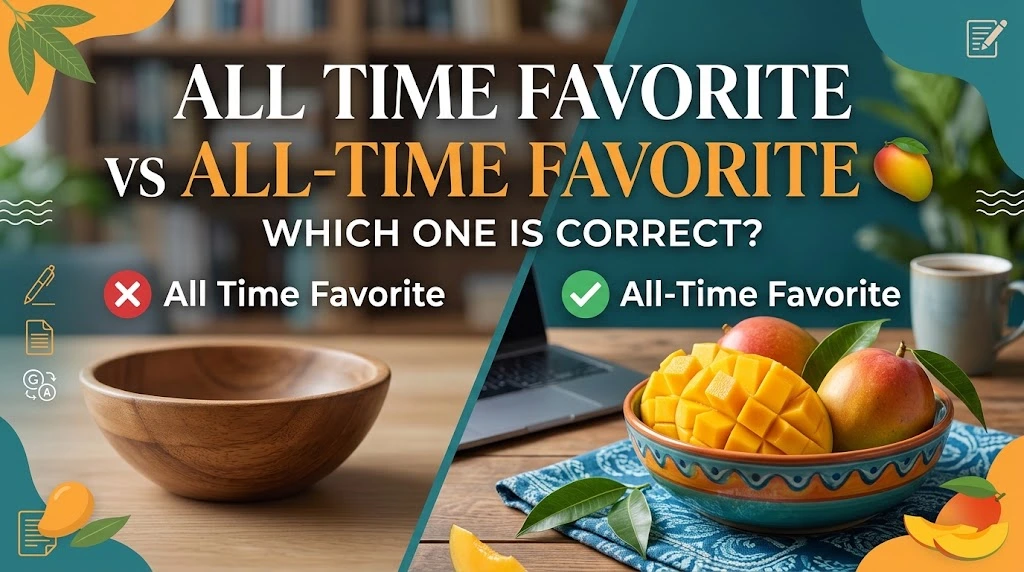
All Time Favorite vs All-Time Favorite is a useful example of how correct spelling and word choice improve English writing across different regions. The United States and the United Kingdom are two countries often described as being separated by a common language, even though English is the most widely used language in both countries. The distinction between
American English and British English reflects differences in the English used in the United States and the English used in the United Kingdom. These two varieties of English share many rules, but subtle differences, especially spelling differences, can affect written communication.
Both varieties include different language variations, language conventions, and national varieties that influence written English and standard English. For example, American spelling uses “favorite,” while British spelling traditionally uses “favourite.” These linguistic distinctions, along with vocabulary
differences, grammar differences, pronunciation differences, and common expressions, show how language usage changes between English-speaking countries. Understanding spelling conventions, linguistic variation, and regional English makes communication easier when comparing these varieties. Although differences nonetheless exist, particularly around spelling, both forms are widely understood.
What Does All-Time Favorite Mean?
All-time favorite means something that a person likes more than anything else they have experienced over their entire life or during a particular period.
The phrase usually describes a person, thing, activity, place, movie, song, book, food, or experience that ranks as the favorite of all time.
For example:
- “Pizza is my all-time favorite food.”
- “That is my all-time favorite song.”
- “She is my all-time favorite actress.”
- “This remains my all-time favorite book.”
Here, all-time works as a compound adjective modifying a noun.
The word favorite can also function as a noun:
- “This movie is my all-time favorite.”
- “That restaurant is still my all-time favorite.”
In American English, favorite is spelled without the u. British English generally uses favourite.
Therefore:
| American English | British English |
| all-time favorite | all-time favourite |
| favorite movie | favourite film |
| my favorite song | my favourite song |
The grammatical principle remains the same in both varieties.
Why Is All-Time Favorite Usually Hyphenated?
The hyphen in all-time helps show that the two words work together as one descriptive unit.
When two or more words combine to act as an adjective before a noun, English often uses a compound modifier with a hyphen.
Consider:
- an all-time favorite movie
- an all-time record
- an all-time high
- an all-time low
- an all-time best-selling author
Without the hyphen, the reader may initially have to work harder to understand how the words relate to one another.
The hyphen therefore improves clarity and readability.
Compare:
This is my all-time favorite movie.
The meaning is immediately clear: this movie is the speaker’s favorite of all time.
The phrase all-time tells us that the ranking covers the entire relevant period, while favorite identifies the preferred thing.
All Time Favorite vs All-Time Favorite: The Main Difference
The most important distinction is whether all-time is functioning as part of a compound expression.
| Form | Correct? | Typical use | Example |
| all-time favorite | Yes | Standard compound expression | This is my all-time favorite book. |
| all time favorite | Usually no | Common informal omission of the hyphen | This is my all time favorite book. |
| all time | Yes in other structures | Means the entire period or every moment, depending on context | We have all the time we need. |
| all-time | Yes | Compound adjective | She holds the all-time record. |
The phrase all-time favorite is the standard choice when you mean favorite of all time.
For example:
Correct:
“This is my all-time favorite movie.”
Less standard:
“This is my all time favorite movie.”
The second version is widely seen online, in casual writing, and in social media. However, careful edited English generally prefers the hyphenated form.
Sentence Structure of All-Time Favorite
Understanding the sentence structure makes this phrase easy to use.
The most common pattern is:
Subject + linking verb + possessive determiner + all-time favorite + noun
Examples:
- “This is my all-time favorite song.”
- “That was her all-time favorite vacation.”
- “Pizza is his all-time favorite food.”
- “The novel became their all-time favorite book.”
Another common structure is:
Subject + linking verb + possessive determiner + all-time favorite
Examples:
- “This is my all-time favorite.”
- “That one remains her all-time favorite.”
- “The blue version is his all-time favorite.”
The phrase can also appear after a noun phrase:
- “My all-time favorite movie is The Lion King.”
- “Her all-time favorite song is playing on the radio.”
- “Their all-time favorite restaurant is downtown.”
In these examples, all-time favorite works naturally as part of a noun phrase.
Rules for Using All-Time Correctly
There are a few useful rules to remember when using all-time.
Rule 1: Use a hyphen when it forms a compound modifier
When all-time comes before a noun as a combined adjective, use the hyphen.
Examples:
- all-time favorite movie
- all-time favorite player
- all-time record
- all-time high
- all-time low
Rule 2: Do not remove the hyphen simply because the phrase is common
Because people frequently see all time favorite online, they may assume that the hyphen is unnecessary. In standard writing, however, all-time favorite is the safer and more polished form.
Rule 3: Favorite can be a noun
You can say:
“This is my all-time favorite.”
Here, favorite is functioning as a noun, while all-time modifies it.
Rule 4: Do not confuse all-time with all the time
These expressions have different meanings.
All-time usually means throughout the entire history or period being discussed.
All the time usually means very often, continuously, or constantly.
Examples:
- “She is my all-time favorite singer.”
- “She listens to music all the time.”
Rule 5: Follow the style of your publication
Different style guides can have specific preferences about hyphenation. If you are writing professionally, follow the style guide used by your school, company, website, or publication.
Examples of All-Time Favorite in Real Life
Here are several natural examples showing how native speakers commonly use all-time favorite.
Movies and television
- “This is my all-time favorite movie.”
- “That series is one of my all-time favorite shows.”
- “It is still my all-time favorite film.”
Music
- “This is my all-time favorite song.”
- “She is one of my all-time favorite singers.”
- “That album remains an all-time favorite among fans.”
Food
- “Chocolate cake is my all-time favorite dessert.”
- “Pizza is one of my all-time favorite foods.”
- “This is my all-time favorite dish.”
Books
- “That novel is my all-time favorite book.”
- “She called it one of her all-time favorite stories.”
- “This remains an all-time favorite among students.”
Sports
- “He is my all-time favorite player.”
- “That was one of the team’s all-time favorite victories.”
- “She is considered one of the all-time greats.”
Personal experiences
- “Paris was my all-time favorite travel destination.”
- “That was my all-time favorite birthday.”
- “The concert became one of my all-time favorite memories.”
Common Mistakes and How to Correct Them
Learners often make small mistakes with this phrase. Most are related to hyphenation, word order, or confusing similar expressions.
Mistake 1: Writing “all time favorite”
Incorrect or less standard:
“This is my all time favorite movie.”
Better:
“This is my all-time favorite movie.”
Read More;Pent vs Pant: What Is the Difference? Meaning, Spelling, and Usage Explained
Mistake 2: Confusing all-time with all the time
These phrases are not interchangeable.
All-time:
“He is my all-time favorite actor.”
Meaning: He is the actor I have liked most of all.
All the time:
“He watches movies all the time.”
Meaning: He watches movies very frequently or continuously.
Mistake 3: Using “favorite of all the time”
This wording is unnatural.
Incorrect:
“This is my favorite of all the time.”
Correct:
“This is my all-time favorite.”
Or:
“This is my favorite of all time.”
Mistake 4: Adding unnecessary hyphens everywhere
Do not assume that every occurrence of all time must become all-time.
For example:
“We have all the time we need.”
Here, all-time would be incorrect because the phrase is not functioning as the same compound modifier.
Mistake 5: Confusing “favorite” and “favourite”
Both spellings are correct depending on the variety of English.
- favorite — American English
- favourite — British English
Therefore, all-time favorite and all-time favourite are both standard.
All-Time Favorite vs Favorite of All Time
Another important comparison is between all-time favorite and favorite of all time.
Both can express essentially the same idea.
| Expression | Meaning | Example |
| all-time favorite | Favorite across one’s entire experience | This is my all-time favorite song. |
| favorite of all time | Favorite across one’s entire experience | This is my favorite song of all time. |
The first version is more compact.
The second version is also completely natural and often useful when you want to make the meaning especially explicit.
Compare:
“This is my all-time favorite movie.”
“This is my favorite movie of all time.”
Both sentences communicate the same basic idea.
The choice is mostly a matter of style and sentence structure.
Verbs, Tenses, and All-Time Favorite
The phrase all-time favorite is not a verb, so it does not have its own tense. However, it can appear naturally in sentences using different verbs and tenses.
Present tense
“This is my all-time favorite book.”
The verb is connects the subject with the noun phrase.
Past tense
“That was my all-time favorite movie when I was younger.”
The verb was places the statement in the past.
Present perfect
“This has been my all-time favorite song for years.”
The verb phrase has been connects a past situation with the present.
This is a useful example when studying the use of had, has vs have, and other auxiliary verb patterns.
For example:
- “It has been my all-time favorite.”
- “They have considered it their all-time favorite.”
- “It had been my all-time favorite before I discovered another movie.”
Future tense
“This may become my all-time favorite restaurant.”
You can also use future indefinite tense examples such as:
“I will choose this as my all-time favorite.”
The important point is that tenses belong to the verb, not to the phrase all-time favorite.
Clauses and Other Grammar Patterns
The phrase all-time favorite can appear in simple sentences as well as more advanced clauses.
Independent clause
“This is my all-time favorite movie.”
This is a complete independent clause.
With a dependent clause
“Because it has such a great story, it is my all-time favorite movie.”
The first part gives a reason, while the second part contains the main statement.
Relative clause
“This is the all-time favorite movie that I watched last year.”
The relative clause that I watched last year gives additional information about the movie.
Conditional clause
“If I had to choose one movie, this would be my all-time favorite.”
This sentence is useful for understanding conditional structures.
When learning grammar, it is helpful to see how vocabulary works inside complete sentence patterns rather than memorizing isolated words.
All-Time Favorite and Other Compound Adjectives
All-time favorite belongs to a larger group of compound expressions in English.
Compound adjectives often combine words to create one clear description.
Examples include:
| Compound adjective | Example |
| well-known | a well-known writer |
| high-quality | a high-quality product |
| long-term | a long-term plan |
| full-time | a full-time job |
| part-time | a part-time worker |
| old-fashioned | an old-fashioned style |
| all-time | an all-time favorite |
This is why learning compound adjectives can help you understand why all-time favorite normally contains a hyphen.
However, hyphenation in English is not always mechanical. The grammatical position of the words and the intended meaning matter.
For instance:
“She works full time.”
But:
“She has a full-time job.”
Likewise:
“He works all the time.”
But:
“He is an all-time favorite.”
The exact structure determines the punctuation.
Quick Comparison: Correct and Incorrect Forms
Use this table as a quick reference when writing.
| Form | Standard? | Explanation |
| all-time favorite | Yes | Standard compound expression |
| all time favorite | Usually avoid | Common informal form without the expected hyphen |
| favorite of all time | Yes | Natural alternative |
| all-time favourite | Yes | British English spelling |
| favorite all-time | No | Incorrect word order |
| favorite of all the time | No | Unnatural expression |
| all the time | Yes | Different phrase with a different meaning |
| all-time high | Yes | Standard compound adjective |
| all-time low | Yes | Standard compound adjective |
For formal essays, academic work, professional articles, and polished web content, all-time favorite is generally the best choice when that is the intended meaning.
Conclusion
Understanding All Time Favorite vs All-Time Favorite helps you write more clearly and avoid common English grammar mistakes. The standard expression is all-time favorite, with a hyphen connecting the words. Although American English and British English sometimes differ in spelling, this phrase is commonly used in both varieties. Learning these simple spelling conventions and language rules can improve your writing, vocabulary, and everyday communication.
Frequently Asked Questions (FAQs)
1. Is it all time favorite or all-time favorite?
All-time favorite is the standard form when describing something you love or prefer above all others.
2. Why is all-time favorite hyphenated?
The hyphen connects “all-time” into a compound adjective that describes the noun “favorite.”
3. Is all times favorite grammatically correct?
No. All times favorite is generally considered incorrect in standard English. Use all-time favorite instead.
4. Is all-time favorite the same in American and British English?
Yes. Both American and British English use all-time favorite, although British English commonly spells the noun “favourite” with a u.
5. What is an example of all-time favorite in a sentence?
“My all-time favorite movie is Titanic.” This sentence expresses that the movie is your most loved choice.
6. Can I write my all-time favorites?
Yes. My all-time favorites is correct when referring to multiple favorite things, such as songs, books, movies, or foods.