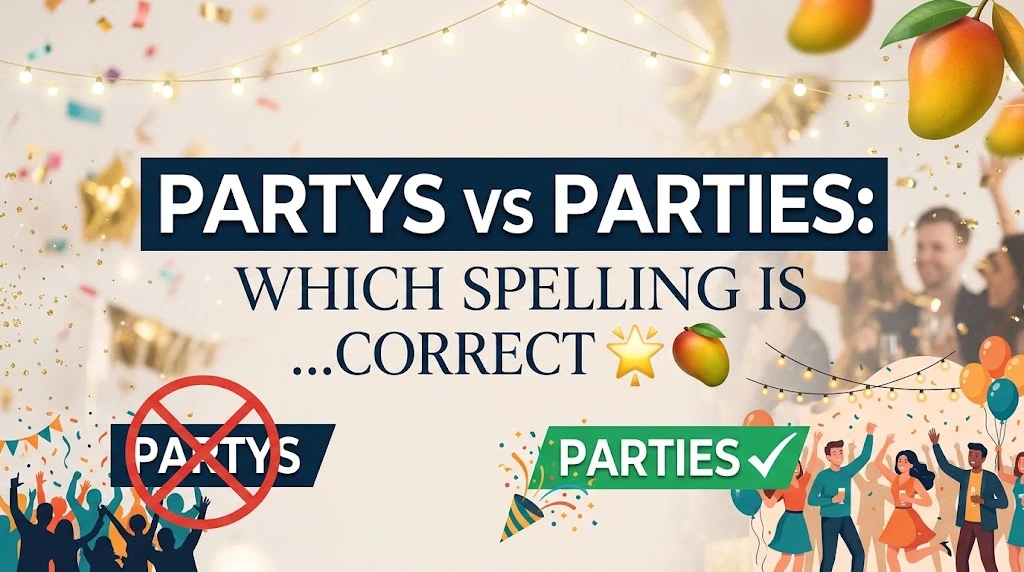
Partys vs Parties is a common grammar question; learn when to use parties as the plural of party and why partys is incorrect in standard English.The words party and parties look similar, but they have different purposes in English writing. A party can mean a social gathering,
such as a birthday party, a political organization, such as a political party, or a group involved in an agreement. For example, one birthday party becomes two birthday parties, while one political party becomes several political parties. In legal terminology, a party to a contract represents
one side in an agreement or legal case, and both parties to a contract refers to the two sides involved. These examples show a singular-to-plural transformation, where the number changes from one to two or several. The correct plural form is parties, not partys, and understanding this difference improves word usage and helps avoid grammar errors.
The spelling rules explain why parties is correct. Many English nouns form their plural by adding -s, but nouns ending in a consonant followed by y follow a different spelling pattern. The consonant plus y rule tells us to change y to ies, so party becomes parties. This common
spelling pattern applies to many nouns ending in y and helps prevent common spelling mistakes. In contrast, party’s is the singular possessive form, using an apostrophe to show ownership, or a contraction meaning party is or party has. The possessive apostrophe makes party’s
different from parties, so party’s vs parties can cause spelling confusion. From an editing perspective, checking whether you mean one party, multiple parties, or something belonging to a party is a simple way to follow standard English grammar and grammar rules.
Partys vs Parties: Definition and Meaning
The main difference between partys and parties is that parties is the correct plural form of party, while partys is an incorrect spelling.
The noun party can have several meanings depending on the context. It can refer to a social gathering, a political organization, a group of people, or one side involved in an agreement or legal matter.
Party as a Social Gathering
A party is often a social event where people meet, eat, talk, dance, or celebrate.
Example:
We are having a birthday party on Saturday.
When there is more than one such event, use parties.
We attended two birthday parties this month.
Party as a Group
Party can also mean a group of people.
The two parties agreed to the contract.
Here, parties does not mean social celebrations. It means two groups involved in an agreement.
Why Is Parties the Correct Plural?
The spelling parties follows a common English pluralization rule.
When a singular noun ends in a consonant + y, the y usually changes to ies when the noun becomes plural.
The pattern is:
consonant + y → consonant + ies
For party:
party → parties
The final y changes to ie, and then s is added.
Other examples include:
| Singular | Plural |
| party | parties |
| city | cities |
| baby | babies |
| country | countries |
| story | stories |
| family | families |
| library | libraries |
Therefore, partys is not the standard English plural spelling.
The Grammar Rule for Words Ending in Y
English has two important rules for nouns ending in y. The letter before y determines which rule you should use.
Consonant + Y
If a noun ends in a consonant followed by y, change y to ies.
Examples:
- party → parties
- city → cities
- puppy → puppies
- lady → ladies
- country → countries
Vowel + Y
If a noun ends in a vowel followed by y, simply add s.
Examples:
- boy → boys
- toy → toys
- day → days
- key → keys
- journey → journeys
This distinction is important because you should not apply the -ies rule to every word ending in y.
Partys vs Parties in Sentence Structure
The correct plural noun parties can be used in many different sentence structures.
Subject of a Sentence
Parties can be the subject of a sentence.
The parties begin at different times.
Object of a Verb
It can also be the object of a verb.
We attended several parties last year.
Object of a Preposition
Parties can follow a preposition.
She went to three parties this summer.
Possessive Form
For possession, use the plural possessive form parties’ when something belongs to several parties.
The parties’ agreement was signed yesterday.
Understanding the role of a noun in a sentence makes it easier to use the correct grammatical form.
Examples of Parties in Everyday English
Here are several practical examples showing how parties is used correctly.
- We went to two birthday parties last weekend.
- The children enjoyed the school parties.
- Several political parties participated in the election.
- Both parties signed the agreement.
- The hotel hosts private parties.
- She organized three graduation parties.
- The two parties could not reach an agreement.
- Many families attend holiday parties.
- The company provides rooms for business parties.
- The students planned separate parties after graduation.
Notice that parties can describe social events as well as groups involved in a discussion, agreement, or political activity.
Common Mistakes With Partys and Parties
One of the most common mistakes is writing partys instead of parties.
Incorrect and Correct Examples
| Incorrect | Correct |
| We went to two partys. | We went to two parties. |
| The partys were crowded. | The parties were crowded. |
| Three partys were planned. | Three parties were planned. |
| Both partys signed the document. | Both parties signed the document. |
Why Do Learners Make This Mistake?
The mistake usually happens because learners simply add s to the singular word:
party + s = partys
However, English does not form the plural this way. Because party ends in consonant + y, the spelling changes:
party → parties
A useful way to remember this is: consonant + y changes to -ies.
Parties vs Other Plural Nouns Ending in Y
Comparing party with similar nouns is an easy way to understand the spelling rule.
| Singular | Correct Plural | Rule |
| party | parties | y → ies |
| city | cities | y → ies |
| family | families | y → ies |
| country | countries | y → ies |
| baby | babies | y → ies |
| boy | boys | add s |
| toy | toys | add s |
| day | days | add s |
| key | keys | add s |
The key question is simple:
Is the letter before y a consonant or a vowel?
If it is a consonant, usually change y to ies.
If it is a vowel, usually add s.
Read More;Success vs Sucess: Which Spelling Is Correct
Verb Usage With Parties
The noun parties works with different verbs, depending on whether you are talking about present, past, or future actions.
Present Tense
The parties agree on the terms.
Because parties is plural, use the plural verb agree, not agrees.
Past Tense
The parties agreed yesterday.
The past-tense form remains agreed.
Future Tense
The parties will meet tomorrow.
The future structure uses will + base verb.
These examples also show why learning nouns alone is not enough. Good English requires you to understand how nouns, verbs, subjects, and objects work together.
Parties and English Tenses
The word parties is a plural noun, so it can appear with many different tenses.
| Tense | Example |
| Present Simple | The parties meet regularly. |
| Present Continuous | The parties are meeting now. |
| Past Simple | The parties met yesterday. |
| Past Continuous | The parties were meeting when we arrived. |
| Present Perfect | The parties have reached an agreement. |
| Past Perfect | The parties had reached an agreement before the meeting. |
| Future Simple | The parties will meet tomorrow. |
The use of had is especially useful when describing an action that happened before another past action.
For example:
The parties had reached an agreement before the lawyer arrived.
Although topics such as has vs have, the use of had, and future indefinite tense examples may seem unrelated to spelling, they are all connected through basic English sentence structure and verb agreement.
Parties in Clauses and Complex Sentences
The word parties can be used in simple sentences as well as more advanced clauses.
Independent Clause
The parties agreed.
This is a complete sentence because it contains a subject and a verb.
Dependent Clause
Although the parties agreed…
This is not a complete sentence by itself because it begins with the subordinating conjunction although.
Complete Complex Sentence
Although the parties agreed, they still needed to sign the contract.
Here, the sentence contains two clauses.
Learning how nouns such as parties work inside clauses can improve both grammar and writing. The same principle applies when studying adjective usage, including searches such as 10 examples of adjective, because each part of a sentence has a specific grammatical function.
Conclusion
Understanding Partys vs Parties helps you avoid common spelling and grammar mistakes. Parties is the correct plural form of party, while partys is incorrect in standard English. On the other hand, party’s shows possession or works as a contraction for party is or party has. Remember the spelling rule: when a noun ends in a consonant followed by y, change y to ies to form the plural. Using these forms correctly will make your English writing clearer and more accurate.
Frequently Asked Questions (FAQs)
1. Is it partys or parties?
Parties is correct when referring to more than one party. Partys is a spelling mistake in standard English.
2. Why does party change to parties?
Because party ends in a consonant followed by y, the spelling rule changes y to ies to form the plural.
3. What is the difference between parties and party’s?
Parties is the plural form of party. Party’s shows ownership or means party is or party has.
4. Is party’s ever correct?
Yes. For example, “The party’s decorations look beautiful” shows possession. “The party’s starting soon” uses party’s as a contraction for party is.
5. Can I write partys in English?
No. In standard English, use parties for the plural of party. Always check the spelling before publishing or submitting your writing.