When writing a note for a friend, Home Made vs Homemade can cause spelling confusion, especially when describing homemade cookies or baking gifts for someone special. Both forms appear in writing, but homemade is the standard modern spelling.
In English grammar, homemade is a compound word written as one word. The two-word form, home made, appears in some contexts and older texts, while home-made is a hyphenated form found in older writing and some style conventions. These spelling differences may create uncertainty for native speakers and language learners.
Checking modern dictionaries and dictionary entries helps explain the correct spelling, clarify the meaning of homemade, and improve writing confidence without having to second-guess yourself.
The key is to consider current grammar standards, standard English, and contextual meaning. Homemade food, homemade products, and homemade goods are prepared or created at home. Examples include homemade cookies, handmade crafting projects,
a recipe card, and a craft label. Although the written form may vary in casual posts, informal writing, and formal writing, choosing homemade usually provides the clearest word choice for sentence writing, everyday writing, and real-world scenarios.
This guide explores grammar logic, spelling rules, spelling conventions, and compound word spelling. It also compares British English and American English, discusses style guides and dictionary standards, and provides real-life examples showing the word in action. Understanding why this
little word carries more weight than expected can prevent common mistakes, reduce spelling mistakes, and make English writing more accurate. These points can help FAHAD, GrammarEra, and anyone studying
NLP-related terms understand compound words, hyphenated words, both versions, and written language while learning to consistently choose the correct usage.
Home Made vs Homemade: Quick Answer
The short answer is that homemade is the standard and most common spelling when you mean “made at home.”
Homemade is normally written as one word and functions as an adjective.
Homemade means made at home rather than bought from a store or produced commercially.
Examples:
- We ate homemade pizza.
- My grandmother makes homemade jam.
- He gave me a homemade card.
- They sell homemade cakes.
- She prepared a homemade meal.
Home made, as two words, is sometimes encountered, especially in older writing or when the words are being used more literally. However, for ordinary modern English, homemade is the safer choice.
What Does Homemade Mean?
Homemade is an adjective that describes something made at home.
The word is formed from:
- home + made = homemade
The adjective usually suggests that a person made something personally or that it was prepared in a domestic setting rather than manufactured commercially.
For example:
- homemade bread
- homemade soup
- homemade cookies
- homemade clothes
- homemade furniture
- homemade decorations
The word made comes from the verb make. Its forms are:
| Verb form | Example |
| make | I make bread. |
| makes | She makes bread. |
| made | She made bread. |
| making | She is making bread. |
Although made is a verb form, homemade as a whole normally acts as an adjective.
Is Home Made Ever Correct?
Home made is not normally the preferred spelling of the adjective in contemporary standard English. However, seeing the two words separately does not automatically mean the sentence is meaningless or impossible.
English has many compound expressions whose spelling can vary according to context, style, or historical usage. The important point is that homemade is the established dictionary-style spelling for the adjective meaning “made at home.”
Compare:
- She sells homemade bread. ✅
- She sells home made bread. ⚠️ Less standard in modern usage.
For schoolwork, professional writing, websites, and general English, choose homemade.
The closed form is especially natural before a noun:
We enjoyed a homemade dinner.
It can also appear after a linking verb:
The cookies are homemade.
Sentence Structure With Homemade
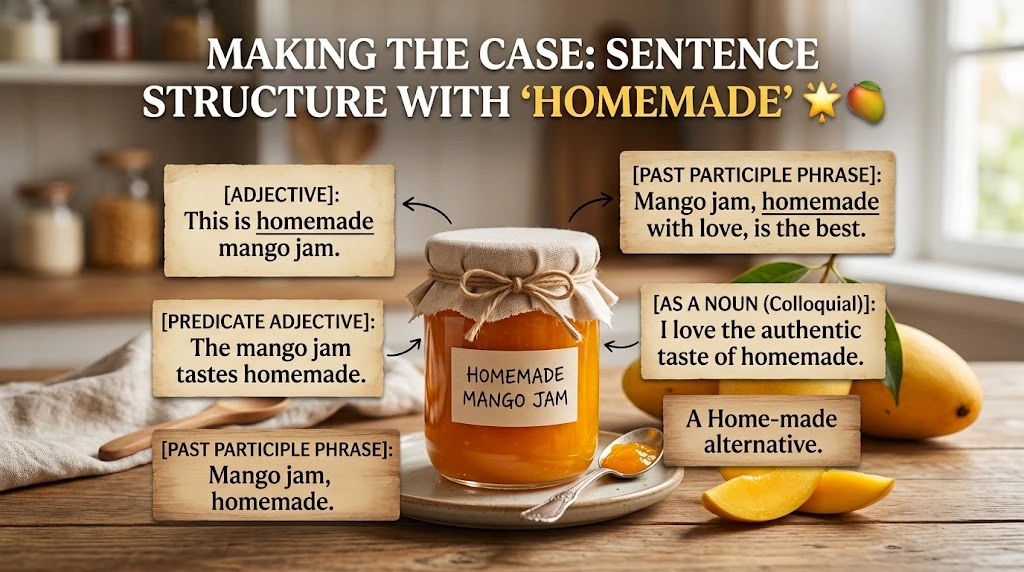
Understanding sentence structure makes this word easier to use correctly.
The most common pattern is:
Subject + verb + homemade + noun
Examples:
- She baked homemade cookies.
- We prepared homemade soup.
- They sell homemade cakes.
- I bought a homemade gift.
Another common pattern is:
Subject + linking verb + homemade
Examples:
- The bread is homemade.
- These cookies are homemade.
- The decorations were homemade.
Here, homemade is a subject complement because it describes the subject after a linking verb such as is, are, or were.
You can also use it in longer sentence patterns:
My mother makes homemade food whenever our family visits.
The adjective homemade modifies the noun food.
Homemade as an Adjective
The main grammatical use of homemade is as an adjective.
An adjective gives information about a noun. In homemade cake, the word homemade tells us what kind of cake it is.
Consider these examples:
- homemade cake
- homemade sauce
- homemade bread
- homemade clothes
- homemade toys
Read More;Either vs Eather: Which Is Correct? Meaning, Usage, and Examples
This is similar to other compound adjectives such as handmade, custom-made, and store-bought.
For example:
She bought a handmade necklace and brought a homemade cake.
Both handmade and homemade describe nouns.
This is also why questions about the 10 examples of adjective often include words such as homemade, because it clearly describes a person, place, thing, or idea.
Homemade With Verbs
The word homemade does not change according to the verb tense. Instead, the verb changes while homemade remains the same.
Present tense
- I make homemade bread.
- She makes homemade cakes.
- They sell homemade food.
Past tense
- I made homemade bread yesterday.
- She prepared homemade soup.
- They sold homemade cookies.
Present continuous
- She is making homemade pizza.
- We are preparing homemade snacks.
Present perfect
- She has made homemade bread.
- They have prepared homemade meals.
Notice that homemade does not become homemaded. The verb changes, but the adjective stays unchanged.
Homemade and English Tenses
Although homemade is not itself a tense, it can appear naturally with almost any English tense.
| Tense | Example |
| Simple Present | She makes homemade bread. |
| Simple Past | She made homemade bread. |
| Simple Future | She will make homemade bread. |
| Present Continuous | She is making homemade bread. |
| Past Continuous | She was making homemade bread. |
| Present Perfect | She has made homemade bread. |
| Past Perfect | She had made homemade bread. |
| Future Perfect | She will have made homemade bread. |
For example, if you are studying the use of had, you might write:
She had made homemade bread before the guests arrived.
Here, had made is the past perfect verb phrase, while homemade is an adjective modifying bread.
Likewise, future indefinite tense examples can include this word:
She will make homemade cookies tomorrow.
Therefore, learning homemade can also help students understand how adjectives fit into different tenses and sentence patterns.
Homemade vs Handmade vs Home-Cooked
These words are related, but they do not have exactly the same meaning.
| Word | Meaning | Example |
| homemade | Made at home | homemade cookies |
| handmade | Made by hand | handmade jewelry |
| home-cooked | Cooked at home | home-cooked dinner |
| store-bought | Bought from a store | store-bought bread |
Homemade is a broad term. It can describe food, crafts, decorations, clothing, furniture, and many other things.
Home-cooked is more specific. It normally describes food that has been cooked at home.
For example:
- We ate homemade cookies. ✅
- We ate a home-cooked meal. ✅
- She bought a handmade bag. ✅
- He purchased store-bought bread. ✅
Using the correct adjective makes your meaning clearer.
Common Mistakes With Home Made and Homemade
Learners often make spelling mistakes with compound words. Here are some common examples.
Mistake 1: Writing “home made” as the standard adjective
I brought home made cookies. ❌
Better:
I brought homemade cookies. ✅
Mistake 2: Adding an unnecessary hyphen
She made a home-made cake. ⚠️
Better in modern standard English:
She made a homemade cake. ✅
Mistake 3: Changing homemade into a verb
She homemades cookies every Sunday. ❌
Correct:
She makes homemade cookies every Sunday. ✅
Homemade is an adjective, while make is the verb.
Mistake 4: Confusing homemade with handmade
A cake can be homemade, while a wooden chair may be handmade. The words are related but emphasize different things.
Home Made vs Homemade Comparison Table
The following table gives a quick comparison.
| Feature | Home made | Homemade |
| Spelling | Two words | One word |
| Common modern adjective | Less common | Standard and preferred |
| Meaning | Made at home | Made at home |
| Word type | Usually treated as separate words | Compound adjective |
| Best choice for general writing | No | Yes |
| Example | home made cake | homemade cake |
If you are unsure which form to use, choose homemade.
This is especially important in formal writing, school assignments, articles, product descriptions, and everyday communication.
Homemade in Clauses and Longer Sentences
Clauses are groups of words that contain a subject and a verb. The word homemade can appear naturally inside simple and complex clauses.
Simple clause
She makes homemade bread.
Dependent clause
Because she makes homemade bread, everyone enjoys breakfast.
Relative clause
The cake that she made at home was delicious.
The last example does not use the word homemade, but it expresses the same basic idea.
You can also combine clauses:
We enjoyed the homemade cookies because my sister had baked them that morning.
This sentence includes:
- homemade — adjective
- had baked — past perfect verb phrase
- because — subordinating conjunction
- that morning — time expression
Understanding these patterns helps students use vocabulary naturally instead of memorizing isolated words.
More Examples of Homemade in Everyday English
Here are several natural examples you can use in conversation and writing:
- My mother makes homemade bread every weekend.
- We enjoyed a delicious homemade meal.
- She brought homemade cookies to the party.
- He sells homemade candles online.
- I prefer homemade soup to canned soup.
- They served homemade lemonade.
- She gave me a homemade birthday card.
- We made homemade decorations for the party.
- This restaurant serves homemade desserts.
- He prepared a homemade pizza for dinner.
- These toys are homemade.
- The jam is completely homemade.
- She has always loved making homemade gifts.
- We will prepare homemade food for our guests.
- They had eaten homemade bread before leaving.
These examples show that homemade can describe both food and non-food items.
Conclusion
The difference between Home Made vs Homemade is simple once you understand modern English spelling rules. Homemade is the standard one-word spelling used for food, gifts, crafts, and other items prepared at home. Although home made and home-made may appear in older texts or certain writing styles, homemade is generally the clearest choice for everyday and formal writing. Using the correct spelling helps improve your writing accuracy and makes your sentences easier to understand.
FAQs
1. Is it home made or homemade?
Homemade is the standard spelling in modern English. It is written as one word when describing something made at home.
2. Is home-made grammatically correct?
Yes, home-made is a recognized variant, particularly in older writing and some style conventions. However, homemade is generally preferred in modern usage.
3. Is homemade one word or two words?
Homemade is one word. The two-word form, home made, is less common in modern standard English.
4. Should I write homemade cookies or home made cookies?
Write homemade cookies because the one-word spelling is the standard modern form.
5. Do British English and American English use homemade differently?
Both British English and American English commonly use homemade. You may encounter home-made in some publications, but homemade is widely accepted in both varieties.
6. Does homemade need a hyphen?
No. Homemade does not need a hyphen in standard modern usage.
7. What does homemade mean?
Homemade describes food, products, or other items made at home rather than manufactured commercially or purchased ready-made.
8. Which spelling is best for SEO content?
Use homemade consistently in titles, headings, and article text when it fits naturally. Focus on clear, helpful content rather than repeating the keyword excessively.