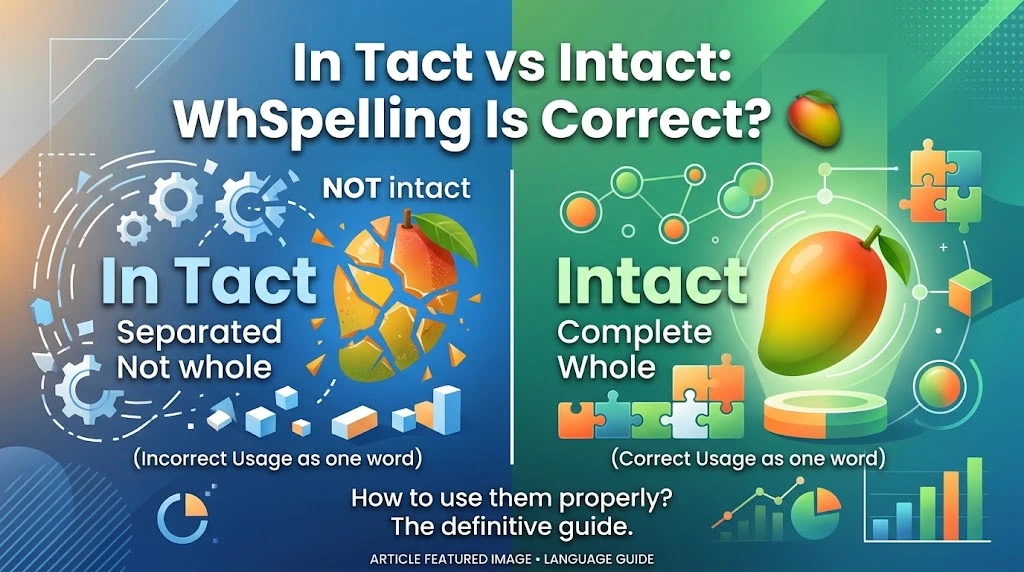
In Tact vs Intact explains a common spelling mistake: adding an unnecessary space to a single word. Although in and tact are real English words, intact is the correct spelling in standard English when describing something that remains complete, unbroken, unharmed, or in its original condition. For example, “The package arrived intact” is correct, while “The
package arrived in tact” is an incorrect expression and a nonstandard spelling. According to the Merriam-Webster Dictionary, perfect relates to soundness, excellence, and the quality of every part, element, or aspect of a thing. However, perfect and intact have different meanings.
Perfect can suggest completeness, flawlessness, or high quality, while intact describes the completeness of a whole or an undamaged condition. Perfection may represent an unattainable state or a theoretical state, whereas intactness describes an observable condition.
This spelling confusion often happens when writers rely on pronunciation instead of checking word formation and grammatical function. Intact is an established word, a single adjective, and not a compound word in this usage. Understanding this difference improves English grammar,
vocabulary, word recognition, and grammatical accuracy. In emails, blogs, academic writing, and other written communication, using the correct word form supports writing accuracy and professionalism. Even a minor detail can weaken content or affect clarity when it creates a
common grammar error. From an editing perspective, checking word spacing, sentence structure, and spelling conventions helps remove common errors and improve language clarity. Correct spelling strengthens professional writing, builds confidence, and supports everyday English usage and English usage overall. Learning the spelling
rules also develops writing skills, English proficiency, communication, language accuracy, and writing clarity. Through proper usage, recognition of incorrect spelling, and practice with sentence examples, writers can improve both spoken English and written English. This knowledge helps remove errors, prevents the splitting of a word, and makes well-written
content and well-written text more reliable. Although perfect condition, ideal condition, excellent condition, sound condition, ideal state, and perfect state describe different levels of quality and excellence, terms such as individual parts, essential elements, overall quality, quality assessment, correctness, integrity, standard of excellence,
ideal standard, unattainable perfection, and theoretical perfection concern how something is evaluated, not alternative spellings of intact. These distinctions help explain grammatical structure, adjective usage, and the language rules behind accurate English writing.
Definition of Intact and In Tact
What Does Intact Mean?
Intact is an adjective that means whole, complete, undamaged, or unchanged.
Examples:
- The old building is still intact.
- The box arrived intact.
- She kept the original document intact.
- The machine remained intact after the accident.
The word can describe physical objects, systems, relationships, traditions, records, or ideas.
Is In Tact Correct?
When you want to say that something is whole or undamaged, in tact is not the standard spelling. Use intact instead.
Likewise, intactr is not a standard English word. It is most likely a typing or spelling mistake.
Quick answer:
Intact is correct when you mean “whole,” “complete,” or “undamaged.”
Intact as an Adjective
The word intact functions mainly as an adjective. An adjective gives information about a noun or pronoun.
For example:
- The painting remained intact.
- The evidence was intact.
- His confidence stayed intact.
- The historical record is still intact.
In each sentence, intact describes the condition of something.
This is different from many words connected with verbs, because intact does not describe an action. Instead, it describes a state or condition.
Common Meaning of Intact
The most common meanings of intact include:
- Not damaged
- Not broken
- Complete
- Unchanged
- Still existing in its original condition
For example, if a glass falls but does not break, you can say:
The glass remained intact.
Sentence Structure With Intact
Because intact is an adjective, it can appear in several common sentence structures.
Subject + Linking Verb + Intact
This is one of the simplest patterns:
Subject + be + intact
Examples:
- The building is intact.
- The documents are intact.
- The system was intact.
- The equipment remained intact.
The verb be connects the subject with the adjective intact.
Subject + Verb + Object + Intact
You can also use intact after an object in certain structures:
- They kept the original design intact.
- We found the package intact.
- The team left the structure intact.
Here, intact describes the condition of the object.
In Tact vs Intact vs Intactr
These three forms can easily cause confusion, but they do not have equal status in standard English.
| Form | Correct? | Meaning | Example |
| intact | Yes | Whole, complete, undamaged | The package arrived intact. |
| in tact | No for this meaning | Incorrect spacing of intact | The package arrived in tact. |
| intactr | No | Misspelling | Avoid intactr. |
The safest choice is simple: use intact.
Rules for Using Intact Correctly
There are a few easy rules to remember.
Rule 1: Use Intact as One Word
When you mean “whole” or “undamaged,” always write intact as one word.
Correct:
The ancient structure remains intact.
Incorrect:
The ancient structure remains in tact.
Rule 2: Intact Usually Describes a Noun
Because intact is an adjective, it normally describes a person, object, system, condition, or thing.
Examples:
- an intact package
- an intact relationship
- an intact document
- an intact system
- an intact structure
Rule 3: Do Not Write Intactr
Intactr is not the correct spelling of this adjective.
If you are proofreading an essay, email, assignment, or website content, replace intactr with intact.
10 Examples of Intact in Sentences
Here are useful real-life examples showing the correct use of intact:
- The package arrived intact despite the long journey.
- The museum carefully preserved the ancient statue intact.
- The documents were found intact after the fire.
- The glass remained intact after being dropped.
- The original design is still intact.
- The rescue team found the building largely intact.
- Please keep the label intact until you return the product.
- The historical records have survived intact for centuries.
- His trust in his friend remained intact.
- The computer files were recovered intact.
These examples show that intact can describe both physical and non-physical things.
Intact and Related Verbs
Although intact is an adjective, it commonly appears with different verbs.
Some useful verbs include:
| Verb | Example |
| remain | The structure remained intact. |
| keep | They kept the original design intact. |
| leave | The workers left the equipment intact. |
| preserve | The museum preserved the artwork intact. |
| find | They found the documents intact. |
| stay | The system stayed intact. |
Notice that the verb changes according to the subject and tense, while intact normally remains unchanged.
For example:
- Present: The building remains intact.
- Past: The building remained intact.
- Future: The building will remain intact.
Intact and English Tenses
The adjective intact does not have different tense forms. Instead, the verb in the sentence changes to show time.
Present Tense
- The package is intact.
- The documents remain intact.
Past Tense
- The package was intact.
- The documents remained intact.
Future Tense
- The package will remain intact.
- The documents will be intact.
This is similar to other grammar topics involving tenses, including the use of had, has vs have, and future indefinite tense examples. The important point is that intact stays the same while the verb changes.
Intact in Clauses and Longer Sentences
Intact can be used in independent and dependent clauses.
Examples:
- The package remained intact after it was transported across the country.
- We discovered that the original document was still intact.
- Although the building was damaged, several rooms remained intact.
- The technician confirmed that the system was completely intact.
In these examples, clauses provide additional information about the condition of something.
Read More;Vender vs Vendor: Which Spelling Is Correct
Common Sentence Patterns
You may see patterns such as:
Although + clause, subject + verb + intact
Although the house was damaged, the main structure remained intact.
Subject + verb + that + clause
The inspector confirmed that the equipment was intact.
Learning these patterns can make your writing clearer and more natural.
Common Mistakes With Intact
English learners often make spelling and grammar mistakes with this word.
Mistake 1: Writing In Tact
Incorrect:
The package arrived in tact.
Correct:
The package arrived intact.
Mistake 2: Writing Intactr
Incorrect:
The original document was intactr.
Correct:
The original document was intact.
Mistake 3: Treating Intact as a Verb
Incorrect:
They intacted the original design.
Better:
They kept the original design intact.
Or:
They preserved the original design.
Mistake 4: Confusing Intact With Entire
Intact and entire can sometimes be related in meaning, but they are not interchangeable in every sentence.
Intact emphasizes that something has remained whole or undamaged.
Entire generally means whole or complete in quantity or extent.
For example:
- The vase remained intact.
- I read the entire book.
Intact vs Other Similar Words
Understanding related words can make the difference easier to remember.
| Word | Meaning | Example |
| intact | Whole or undamaged | The package is intact. |
| complete | Having all necessary parts | The project is complete. |
| whole | Not divided or broken | The apple is still whole. |
| undamaged | Not harmed or damaged | The car was undamaged. |
| unchanged | Not altered | The original plan remains unchanged. |
| entire | Whole in quantity or extent | She spent the entire day studying. |
These words are semantic keywords related to intact, but each has its own typical use.
Conclusion
In conclusion, In Tact vs Intact is a common spelling confusion, but intact is the correct standard English word when you mean something that remains whole, undamaged, or unchanged. For example, “The package arrived intact” means the package arrived without damage. In tact is generally a nonstandard spelling when used with this meaning. Understanding the correct spelling, definition, grammar, and usage of intact can help you avoid common writing mistakes and improve your English accuracy.
Frequently Asked Questions (FAQs)
1. Is it in tact or intact?
Intact is the correct spelling when describing something that remains whole or undamaged. “In tact” is not standard for this meaning.
2. What does intact mean?
Intact means complete, whole, or not damaged. For example, “The glass remained intact after the move.”
3. Is in tact ever correct?
The phrase in tact is generally incorrect when you mean whole or undamaged. The words “in” and “tact” can appear separately in other grammatical contexts, but they do not replace intact.
4. How do you use intact in a sentence?
You can use intact as an adjective. For example: “Despite the long journey, the equipment arrived intact.”
5. What is the difference between in tact and intact?
Intact is one word that means whole or undamaged. In tact is a commonly confused spelling and is not the standard form for this meaning.
6. What are synonyms for intact?
Common synonyms for intact include whole, complete, undamaged, unbroken, preserved, and untouched, depending on the context.
7. Is intact an adjective?
Yes, intact is an adjective. It describes a person, object, system, or situation that remains whole or unchanged.
8. What is an example of intact in everyday English?
“The original document is still intact.” This means the document has not been damaged, altered, or separated into pieces.