Bearable vs Bareable is a common spelling question because both words sound alike, but only one is correct in standard English.Have you ever typed bareable and paused, wondering whether it looks right because it sounds correct? You are not alone; thousands of people search for this spelling
comparison every month because the two words look almost identical and have similar sounds. In English, pronunciation does not always match structure, which causes spelling confusion and common spelling errors. Many people rely on sound when writing the word, but word origin, language rules, and word structure also matter for English spelling.
Although bear and bare sound the same, they have different meanings. These commonly confused words are homophones, and learning their word definitions can improve spelling habits, written English, and English vocabulary. Understanding these spelling differences helps improve spelling accuracy and makes it easier to choose the correct form instead of the incorrect form.
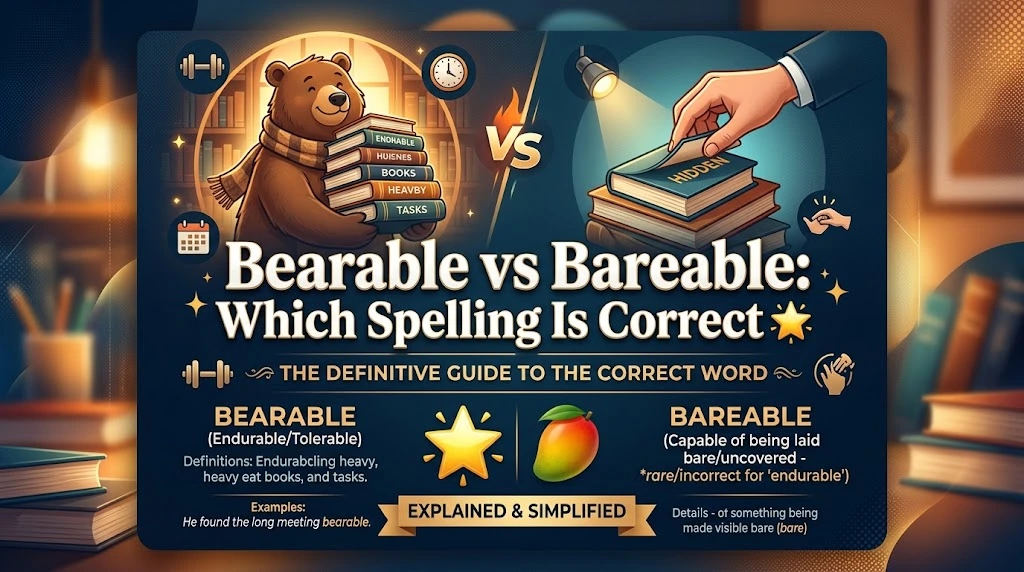
The correct spelling is bearable, meaning able to be endured, tolerated, or dealt with. It describes endurance, tolerance, and dealing with difficulties, such as making a stressful day easier to manage. In modern standard English, bareable is a misspelling, not the standard spelling.
When checking word usage, connecting a word to its meaning is more helpful than relying only on word sounds. Bearable is the correct word, while bareable is the incorrect word and an incorrect spelling. Using the correct English spelling supports correct word usage, correct usage, and accurate English grammar. If you have wondered, hesitated, or
experienced spelling uncertainty while writing, remember that word choice depends on meaning as well as sound. You can avoid these spelling errors by learning the spelling rules and checking the written word before publishing or submitting work. This habit makes written words clearer for readers and supports accurate, everyday language usage.
What Does Bearable Mean?

Bearable is an adjective formed from the verb bear. In this context, bear means to tolerate, endure, or put up with something difficult.
The suffix -able means “capable of” or “fit to be.” Therefore, bearable describes something that a person can endure.
Simple Definition of Bearable
Bearable means:
- able to be tolerated
- able to be endured
- not too difficult to experience
- manageable despite being unpleasant
- possible to put up with
For example:
- The heat was bearable in the evening.
- Her headache became more bearable after resting.
- The noise was annoying but still bearable.
- The waiting time was bearable because we had something to read.
The word can describe pain, weather, noise, stress, waiting, discomfort, situations, and experiences.
What Does Bareable Mean?
Bareable is usually not the word you want when discussing something that can be tolerated.
The confusion comes from the word bare, which is a real English word. Bare means uncovered, empty, plain, or lacking something.
For example:
- The walls were bare.
- He walked with bare feet.
- The room contained only the bare essentials.
- The tree had bare branches.
Adding -able to a word does not always create a standard English adjective. Although bareable may occasionally appear in informal or specialized contexts, it is not the standard spelling used to mean “able to be endured.”
Bearable vs Bareable at a Glance
| Word | Standard usage | Meaning |
| Bearable | Correct | Able to be tolerated or endured |
| Bareable | Usually incorrect for this meaning | Not the standard form of “able to be endured” |
Therefore, if you want to describe something that is difficult but possible to tolerate, choose bearable.
Bearable vs Bareable: The Main Difference
The easiest way to remember the difference is to look at the base words.
Bearable comes from bear, meaning to tolerate or endure.
Bareable appears to come from bare, meaning uncovered or exposed, but it is not the normal English adjective for something that can be endured.
Compare the Base Words
| Base word | Meaning | Related word |
| Bear | To tolerate or endure | Bearable |
| Bare | Uncovered or exposed | Bare |
Consider these examples:
- The pain is bearable.
- The pain is bareable. ❌
The first sentence means the pain can be tolerated. The second uses a nonstandard spelling for that intended meaning.
A useful memory trick is:
Bearable = you can bear it.
If you can bear something, it is bearable.
Sentence Structure With Bearable
Because bearable is an adjective, it commonly appears after a linking verb such as is, are, was, were, seems, feels, becomes, or remains.
Common Sentence Pattern
Subject + linking verb + bearable
Examples:
- The pain is bearable.
- The temperature was bearable.
- The noise became bearable.
- The situation seems bearable.
- The workload remains bearable.
Another common structure is:
Subject + linking verb + adverb + bearable
Examples:
- The pain is quite bearable.
- The weather was reasonably bearable.
- The waiting time became more bearable.
You can also use bearable before a noun:
- a bearable level of pain
- a bearable temperature
- a bearable workload
- a bearable amount of noise
This is an important part of understanding sentence structure because adjectives can appear in different positions.
Rules for Using Bearable Correctly
There are several simple rules that make the use of bearable easy.
Rule 1: Use Bearable for Something That Can Be Endured
Use bearable when something is unpleasant, difficult, painful, or uncomfortable but can still be tolerated.
- The pain is bearable.
- The cold is bearable with a warm jacket.
- The workload is bearable this week.
Rule 2: Use Bearable as an Adjective
Bearable describes a noun or tells us about the condition of something.
- The heat is bearable.
- It was a bearable experience.
Rule 3: Do Not Use Bareable as the Standard Spelling
When your intended meaning is “able to be tolerated,” write bearable, not bareable.
Incorrect:
- The situation was bareable. ❌
Correct:
- The situation was bearable. ✅
Rule 4: Use More Bearable for Comparison
When comparing two situations, you can use more bearable.
- The second half of the journey was more bearable.
- The new schedule is more bearable than the old one.
The opposite is less bearable.
- The heat became less bearable in the afternoon.
Examples of Bearable in Everyday English
The word bearable is common in everyday descriptions of discomfort and difficult experiences.
Examples
- The pain was bearable after taking a break.
- The weather became bearable after sunset.
- The noise was annoying but bearable.
- The long journey was bearable because we stopped several times.
- The workload is bearable this month.
- The waiting period was bearable.
- The cold became more bearable after we found shelter.
- The stress was difficult but still bearable.
- The movie was boring, but the two-hour length was bearable.
- The heat is hardly bearable at midday.
These examples also show why bearable is useful in many different contexts.
Bearable in Formal Writing
You may also find bearable in essays and formal writing:
- The economic burden became increasingly bearable after the policy change.
- The level of discomfort remained bearable.
- The working conditions were considered bearable by most employees.
Bearable With Verbs and Tenses
Although bearable itself is an adjective, it often works with different forms of the verb be and other linking verbs.
The related verb is bear.
Forms of Bear
| Form | Word |
| Base form | bear |
| Past tense | bore |
| Past participle | borne / born in specific uses |
| Present participle | bearing |
| Adjective | bearable |
Examples:
- I cannot bear the noise.
- She bore the pain bravely.
- They are bearing the pressure well.
- The situation is bearable.
The verb bear is irregular, so its past tense is bore, not “beared.”
Bearable and Tenses
The adjective itself does not change for tense. Instead, the verb around it changes.
Present:
The pain is bearable.
Past:
The pain was bearable.
Future:
The pain will be bearable.
These examples show the connection between adjectives, verbs, and tenses.
Bearable in Clauses and Complex Sentences
Bearable can appear in simple sentences as well as dependent and independent clauses.
For example:
The heat was bearable.
This is a simple sentence containing a subject, linking verb, and adjective.
A more complex sentence can contain a clause:
The heat was bearable because we stayed indoors.
Here, “The heat was bearable” is the main clause, while “because we stayed indoors” is a dependent clause.
Read More;Natzi vs Nazi: Which Spelling Is Correct
More Clause Examples
- Although the journey was long, it was bearable.
- The pain became bearable after the medicine started working.
- If the temperature drops, the weather should become more bearable.
- The workload is bearable because the tasks are divided among the team.
Understanding these patterns helps learners connect vocabulary with broader English grammar concepts.
Common Mistakes With Bearable and Bareable
Spelling mistakes often happen because bear and bare sound similar in some varieties of English.
Mistake 1: Writing Bareable
Incorrect:
The pain was bareable.
Correct:
The pain was bearable.
Mistake 2: Confusing Bear and Bare
Bear can mean tolerate or endure.
I cannot bear the noise.
Bare means uncovered or exposed.
He walked with bare feet.
Because the meanings are completely different, choosing the correct base word is important.
Mistake 3: Writing Beared
A common mistake with the verb is:
She beared the pain. ❌
The correct past tense is:
She bore the pain. ✅
However, bearable is much simpler because it is an adjective.
Quick Correction Guide
| Incorrect | Correct |
| bareable pain | bearable pain |
| the pain is bareable | the pain is bearable |
| it was bareable | it was bearable |
| she beared the pain | she bore the pain |
Bearable vs Other Similar Words
Understanding synonyms can make the meaning of bearable clearer.
| Word | Meaning |
| Bearable | Able to be endured |
| Tolerable | Able to be tolerated |
| Manageable | Possible to deal with |
| Endurable | Able to be endured |
| Unbearable | Too difficult to tolerate |
| Intolerable | Impossible or extremely difficult to tolerate |
For example:
The pain was bearable.
You could also say:
The pain was tolerable.
The opposite is:
The pain was unbearable.
Bearable vs Unbearable
These words form a useful pair:
- Bearable = possible to tolerate
- Unbearable = impossible or extremely difficult to tolerate
Examples:
The heat was bearable in the morning.
By afternoon, the heat became unbearable.
This contrast is particularly useful for students learning descriptive adjectives.
Bearable, Adjectives, and English Grammar
Bearable is an adjective, so it belongs to the same broad grammar category as words such as comfortable, acceptable, manageable, tolerable, and possible.
If you are studying the 10 examples of adjective concept, bearable can be included as one example:
- The pain is bearable.
- The weather is comfortable.
- The task is manageable.
- The answer is acceptable.
- The situation is difficult.
- The room is quiet.
- The water is cold.
- The road is dangerous.
- The exercise is easy.
- The movie is interesting.
These examples demonstrate how adjectives describe people, places, things, situations, or experiences.
The important point is that bearable does not act like a main verb. It normally needs a suitable verb such as is, was, seems, feels, becomes, or remains.
Bearable in Different Tenses and Sentence Patterns
Although bearable remains unchanged, it can be used with different tenses.
Present Simple
The workload is bearable.
Past Simple
The workload was bearable.
Future Simple
The workload will be bearable.
This can also help when studying future indefinite tense examples:
- The weather will be bearable tomorrow.
- The journey will be bearable with enough breaks.
- The workload will be bearable after the deadline.
Present Perfect
The situation has become bearable.
Notice the use of has with a singular subject.
This is also a useful way to understand has vs have:
- The situation has become bearable.
- The conditions have become bearable.
Past Perfect
The situation had become bearable by evening.
This demonstrates the use of had with all subjects in the past perfect:
- I had become accustomed to it.
- She had found the situation bearable.
- They had decided to continue.
Conclusion
The correct spelling is bearable, not bareable. Bearable means something that can be endured, tolerated, or managed, especially during a difficult situation. Although bear and bare sound the same, their meanings and spelling differ. Remembering the correct spelling helps you avoid common English spelling mistakes and improve your writing accuracy.
Frequently Asked Questions (FAQs)
1. Is it bearable or bareable?
Bearable is the correct spelling in standard English. Bareable is generally considered a misspelling.
2. What does bearable mean?
Bearable means something that can be endured, tolerated, or dealt with without becoming too difficult to manage.
3. Why do people confuse bearable and bareable?
People confuse these words because bear and bare have the same pronunciation in standard English, even though their meanings are different.