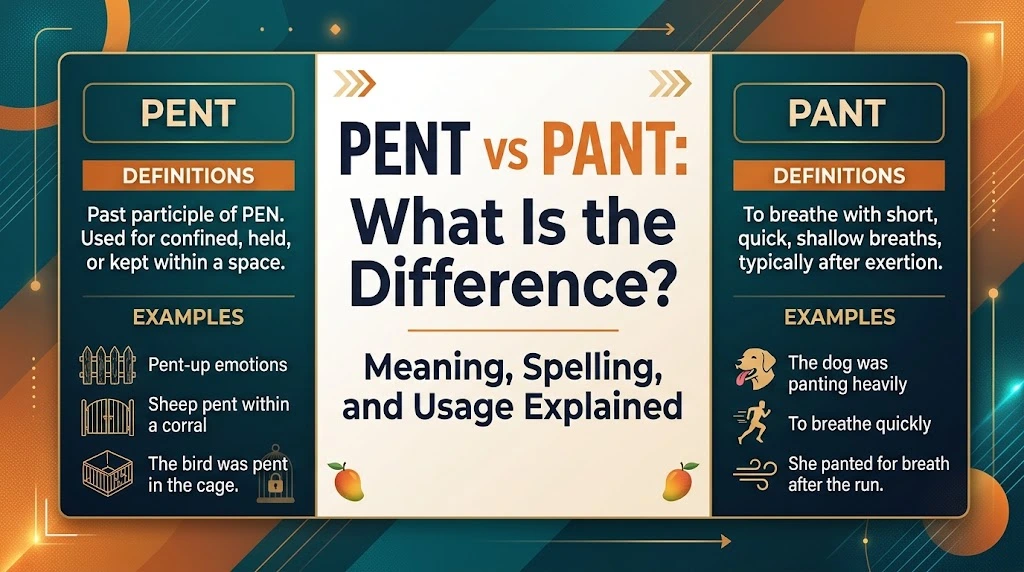
Pent vs Pant becomes easier to understand when you compare their meanings, spelling, and use in everyday English sentences. Both are legitimate words, but their similar spelling can cause confusion among writers and learners. Pent is the past participle of pen, meaning confined,
restricted, held back, shut in, or restrained, and it often describes feelings and emotions that are stored away. For example, “She released her pent emotions after the long meeting.” Learning these
definitions through simple examples can improve English grammar, vocabulary development, writing skills, and writing accuracy while helping language learners avoid common spelling mistakes.
Pant is a verb meaning breathing heavily, often after exercise or running, while pants is a common noun for clothing that covers the body from the waist down in American English. For example, “The dog began to pant after running,” and “He bought a new pair of pants.” Understanding Pant usage,
Pent usage, grammatical roles, word forms, and contextual meaning makes these words easier to distinguish. Their proper meanings, grammatical functions, and surrounding sentence determine the
correct spelling and accurate word choice. By learning these word differences, common usage patterns, and clothing terminology, you can strengthen your vocabulary and use nouns and verbs correctly in everyday writing.
What Does Pent Mean?
Pent is the past participle and sometimes an adjective derived from the verb pen, meaning to confine, enclose, or keep someone or something within a limited space.
For example:
- The animals were pent inside the enclosure.
- His pent-up emotions finally came out.
- The prisoners were pent within the walls.
The word pent is often found in the expression pent-up, which means feelings or emotions that have been held inside for a long time.
Pent as a Verb Form
The verb pen can mean to confine or enclose. Its forms include:
| Verb Form | Example |
| Base form | pen |
| Past form | penned |
| Past participle | penned |
| Less common/archaic form | pent |
In modern everyday English, penned is generally more common as the past and past participle form of pen.
For example:
- The animals were penned in a small area.
- The writer penned a beautiful letter.
However, pent remains recognizable, especially in expressions such as pent-up anger and pent-up emotions.
Read More;Bearable vs Bareable: Which Spelling Is Correct
What Does Pant Mean?
Pant is mainly a verb meaning to breathe quickly and heavily, usually because of exercise, fear, excitement, heat, or physical effort.
For example:
- The dog began to pant after running.
- She was panting after climbing the stairs.
- He panted for breath after the race.
Pant can also be used as a noun in certain contexts, although the verb is the meaning most relevant to this comparison.
The word has several common forms:
| Form | Example |
| Base verb | pant |
| Present participle | panting |
| Past tense | panted |
| Past participle | panted |
| Third-person singular | pants |
Therefore, pant, pants, panted, and panting are related forms of the same verb.
Pent vs Pant: Key Differences
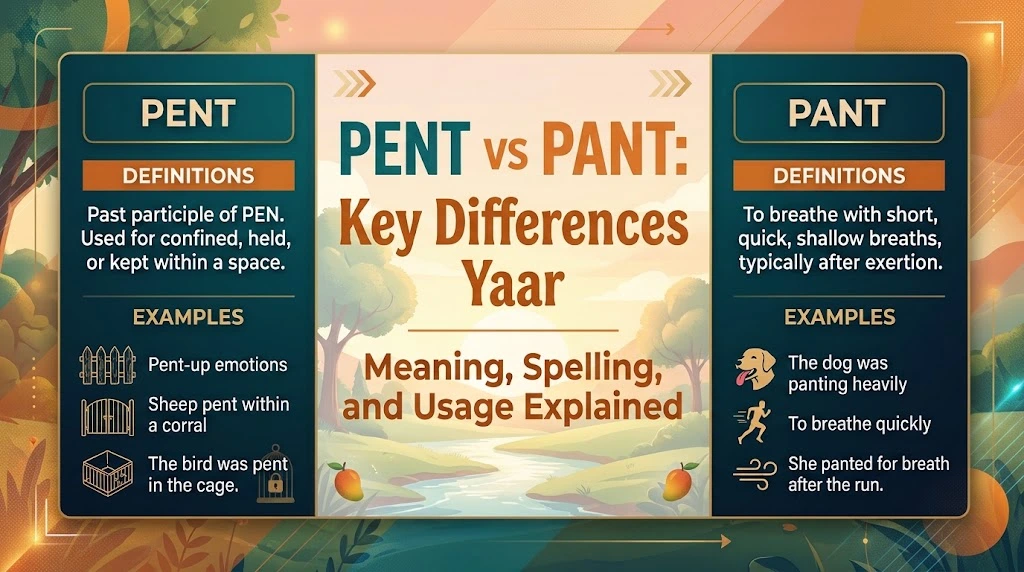
The easiest way to remember pent vs pant is to focus on their meanings.
| Word | Part of Speech | Main Meaning | Example |
| Pent | Verb form/adjective | Confined or enclosed; often used in pent-up | He released his pent-up anger. |
| Pant | Verb | To breathe quickly and heavily | The dog began to pant. |
The words are not interchangeable.
Pent is associated with confinement, enclosure, or suppressed feelings, whereas pant is associated with rapid breathing.
Compare these sentences:
- She had pent-up emotions after the argument.
- She began to pant after running.
The first sentence describes emotions that have been held inside. The second describes heavy breathing.
Pent vs Pant Pronunciation and Spelling
Spelling can make these words confusing for beginners. Pent contains the vowel combination e, while pant contains a.
Their pronunciation is also different in standard English:
- Pent sounds like “pent.”
- Pant has the vowel sound found in words such as “hand” in many English accents.
A useful memory trick is:
Pant = breathing.
Think about a dog that runs quickly and then pants.
Pent = confined.
Think about something being kept inside or pent up.
Learning the spelling together with the meaning is more effective than memorizing the spelling alone.
Sentence Structure and Use of Pent and Pant
Understanding sentence structure makes it easier to use these words correctly.
Common Structures With Pant
When pant is used as a verb, it can appear in several sentence patterns.
Subject + pant
- The dog panted.
Subject + be + panting
- The dog was panting.
Subject + pant + adverbial phrase
- The runner panted heavily after the race.
Subject + pant + for + noun
- He was panting for breath.
Common Structures With Pent
Pent is most commonly seen in combinations such as pent-up + noun.
- pent-up anger
- pent-up frustration
- pent-up emotions
- pent-up energy
Examples:
- She expressed her pent-up frustration.
- His pent-up anger finally disappeared.
- The children had plenty of pent-up energy.
These sentence patterns are useful for students learning how adjectives, verbs, and nouns work together.
Grammar Rules for Pent and Pant
There are several simple rules to remember.
Rule 1: Use Pant for Heavy Breathing
Use pant when someone or something breathes quickly and heavily.
- The horse began to pant.
- The athlete was panting after the workout.
Rule 2: Use Pent for Confinement or Suppressed Feelings
Use pent when referring to something that is confined or held in, especially in the expression pent-up.
- He released his pent-up emotions.
- She finally expressed her pent-up frustration.
Rule 3: Do Not Use Pant When You Mean Confined
Incorrect:
- He released his pant-up anger.
Correct:
- He released his pent-up anger.
Rule 4: Do Not Use Pent for Heavy Breathing
Incorrect:
- The dog began to pent after running.
Correct:
- The dog began to pant after running.
These simple rules eliminate most pent vs pant mistakes.
10 Examples of Pent and Pant in Sentences
Here are practical examples to make the difference easier to remember.
Examples With Pent
- She finally expressed her pent-up emotions.
- His pent-up anger was obvious.
- The animals were pent inside the enclosure.
- Years of pent-up frustration affected his behavior.
- The story describes a character filled with pent-up feelings.
Examples With Pant
- The dog began to pant after chasing the ball.
- The runner was panting heavily after the race.
- The horse panted after climbing the hill.
- The child started to pant after running around the playground.
- The athlete was panting for breath after the difficult exercise.
These 10 examples of adjective and verb usage also show why context is important when choosing between similar-looking words.
Pent vs Pant and Verb Forms
Both words can appear in sentences involving verbs, but they behave differently.
The verb pant has regular forms:
- pant — base form
- pants — third-person singular
- panted — past tense
- panted — past participle
- panting — present participle
Examples:
- I pant after intense exercise.
- She pants after running.
- He panted after the race.
- The dog has panted for several minutes.
- The dog is panting now.
For pen, modern English normally uses penned as its past and past participle form:
- The author penned a letter.
- The poem was penned by a famous writer.
Pent is less common as a standalone verb form in modern English, but it remains established in words and phrases such as pent-up.
Pent vs Pant in Tenses and Clauses
English tenses help show when an action happens. The word pant works naturally across different tenses.
Present Simple
- The dog pants when it gets hot.
Past Simple
- The dog panted after the race.
Present Continuous
- The dog is panting after running.
Present Perfect
- The dog has panted for several minutes.
Future Simple
- The dog will probably pant after the long walk.
These patterns can also help students understand future indefinite tense examples and other basic tense structures.
With pent, the word is often used as part of a noun phrase:
- She has pent-up frustration.
- He expressed his pent-up emotions.
- They released years of pent-up energy.
A clause may contain either word depending on its meaning:
- Because the dog was tired, it began to pant.
- After years of pent-up frustration, she finally spoke.
Notice how the clauses provide context that makes the meaning clear.
Common Mistakes With Pent and Pant
Learners often confuse these words because their spellings are similar.
Mistake 1: Writing “Pant-Up”
Incorrect:
- He released his pant-up anger.
Correct:
- He released his pent-up anger.
The correct expression is pent-up.
Mistake 2: Using “Pent” for Breathing
Incorrect:
- The dog was pent after running.
Correct:
- The dog was panting after running.
Mistake 3: Confusing Pent With Penned
Pent and penned can be related to the verb pen, but they are not always interchangeable in modern usage.
For example:
- The author penned a novel.
- The animal was pent inside the enclosure.
Mistake 4: Ignoring Context
Never choose a word only because it sounds similar to another word. Look at the meaning of the sentence first.
If the sentence is about breathing, choose pant.
If it is about being confined or feelings being held inside, pent may be correct.
Conclusion
Understanding Pent vs Pant is simple when you remember their different meanings and uses. Pent means confined, restricted, or held back, often describing feelings or emotions that are not expressed. Pant means breathing heavily, while pants refers to clothing that covers the body from the waist down in American English. Although these words have similar spelling, they have different grammatical roles and meanings. Learning their correct usage helps you avoid common spelling mistakes, improve your English vocabulary, and choose the right word for every sentence.
FAQs
1. What is the difference between Pent and Pant?
Pent means confined or restrained, while pant means to breathe heavily. Their meanings and grammatical functions are different.
2. Is Pent a correct English word?
Yes, pent is a legitimate but less common English word. It is the past participle of pen, meaning to confine or shut in.
3. What does Pant mean?
Pant is a verb that means to breathe quickly and heavily, often after running, exercise, or physical effort.
4. What is the difference between Pant and Pants?
Pant usually refers to the action of breathing heavily. Pants is a noun for clothing that covers the body from the waist down in American English.
5. How do I use Pent in a sentence?
You can use pent to describe restrained feelings or emotions. For example: “He finally expressed his pent-up anger.” The expression pent-up is more common in everyday English than pent alone.
6. Is Pent the opposite of Pant?
No, pent and pant are not opposites. They have unrelated meanings: one relates to confinement, while the other relates to heavy breathing.
7. How can I remember Pent vs Pant?
Remember that pent relates to being confined or held back, while pant relates to heavy breathing. For clothing, use pants in American English.