English spelling can sometimes be confusing, especially when two words look and sound similar but have completely different meanings. Acception vs exception is one such confusing word pair. Many English learners search for these words because they are unsure whether to write acception or exception in a sentence.
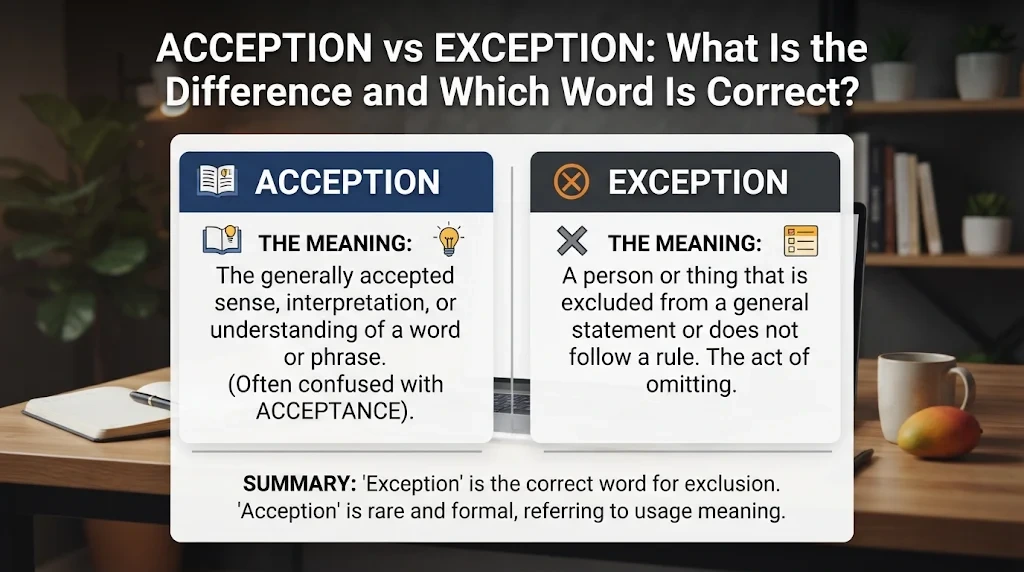
The important thing to know is that exception is the correct and commonly used word in modern English. It refers to someone or something that does not follow a general rule or is different from what is normally expected. On the other hand, acception is an extremely rare and obsolete word that historically referred to a particular meaning or interpretation of something.
Understanding the difference between acception and exception can help you improve your spelling, vocabulary, and sentence structure. In this article, we will explain their definitions, grammatical rules, examples, common mistakes, and practical uses in everyday English.
Acception vs Exception: Quick Difference
The main difference between acception and exception is their meaning and usage.
- Exception is a standard English noun that means someone or something excluded from a general rule.
- Acception is a rare, obsolete noun historically used to describe a particular interpretation or meaning of a word or expression.
Exception is the word you should use in almost all modern writing and everyday conversations.
For example:
- Everyone must follow the school rules without exception.
- There is an exception to every general rule.
Although acception may appear in older dictionaries or historical texts, it is not normally used in contemporary English.
Definition of Acception and Exception
Understanding the dictionary meanings of both words makes it easier to recognize when and how they are used.
What Does Acception Mean?
Acception is a rare and obsolete English noun. Historically, it referred to a particular sense, meaning, or interpretation of a word or expression.
It was sometimes used when discussing how a word was understood in a specific context. However, modern English speakers generally use words such as meaning, interpretation, or sense instead.
For example:
- The old text used a particular acception of the word.
- Its original acception is different from its modern meaning.
These examples demonstrate its historical sense, but they are not recommended for ordinary modern English writing.
What Does Exception Mean?
Exception is a common English noun that refers to a person, thing, or situation that does not follow a general rule or is treated differently from others.
It is frequently used in conversations, academic writing, business communication, and everyday situations.
For example:
- Everyone is invited to the meeting, with one exception.
- My teacher makes an exception for students who are sick.
- This rule applies to everyone without exception.
In simple words, an exception is something that is different from the usual rule or situation.
Sentence Structure of Acception vs Exception
Understanding sentence structure helps you use nouns correctly in English. Both words historically function as nouns, but their modern usefulness is very different.
The word exception commonly appears in several sentence patterns.
1. Subject + verb + exception
Example: The student was an exception.
2. Subject + verb + exception + to + noun
Example: This situation is an exception to the rule.
3. Subject + verb + with the exception of + noun
Example: Everyone attended the class with the exception of Ali.
4. Subject + verb + without exception
Example: All employees must follow the instructions without exception.
For historical discussions, acception can appear in a noun position, but modern writers should generally choose meaning or interpretation instead.
Types and Grammar Rules of Exception
The word exception follows several useful grammatical patterns. Learning these rules will help you use it naturally in different situations.
1. Exception as a Noun
Exception is a countable noun. It identifies something that is different from a general rule.
Examples:
- There is one exception to this policy.
- The teacher allowed an exception.
- Every rule has an exception.
2. The Phrase “With the Exception Of”
This phrase identifies someone or something that is excluded from a group.
Examples:
- Everyone passed the exam with the exception of one student.
- The shops are open every day with the exception of Sunday.
- All the children attended the party with the exception of Ahmed.
3. The Phrase “Without Exception”
This expression means that something applies to everyone or everything without any special treatment.
Examples:
- All students must attend the examination without exception.
- The rules apply to every employee without exception.
- Every application was reviewed without exception.
4. The Phrase “Make an Exception”
This phrase means allowing someone or something to avoid a normal rule.
Examples:
- The manager decided to make an exception.
- My parents made an exception for my birthday.
- The teacher made an exception because I was ill.
5. Exception in Plural Form
The plural form of exception is exceptions.
Examples:
- There are several exceptions to this rule.
- The company has introduced new exceptions.
- These exceptions are clearly mentioned in the policy.
10 Examples of Acception vs Exception in Sentences
The following examples demonstrate how to understand the difference between these two words. Since acception is obsolete, the examples involving it are historical rather than recommended modern usage.
Examples of Exception
- Everyone must complete the assignment without exception.
- My brother is an exception to this family tradition.
- The teacher made an exception for the sick student.
- There is no exception to this important rule.
- All employees attended the meeting with one exception.
- This restaurant is open every day, with the exception of Monday.
- Every student passed the examination, with two exceptions.
- The manager allowed an exception in this special situation.
- There are a few exceptions to the general policy.
- This law applies to everyone without exception.
Historical Examples of Acception
- The author discussed an older acception of the word.
- The historical acception differed from its modern interpretation.
Remember: For contemporary English, use meaning or interpretation instead of acception.
Acception vs Exception: Comparison Table
The following table highlights the important differences between these words.
| Feature | Acception | Exception |
| Part of speech | Noun | Noun |
| Meaning | Historical particular sense or interpretation | Something excluded from a general rule |
| Modern usage | Obsolete and extremely rare | Common |
| Everyday English | Not recommended | Correct and widely used |
| Plural form | Acceptions | Exceptions |
| Grammar role | Noun | Noun |
| Common phrases | Historical usage | Without exception, make an exception |
| Recommended spelling | Avoid in modern writing | Exception |
The easiest way to remember the difference is that exception is the standard modern word when talking about something that does not follow a general rule.
Related Words, Verbs, and Word Forms
Learning related verbs, nouns, and adjectives can improve your English vocabulary. The word exception has several related forms that are useful in everyday communication.
| Word | Part of Speech | Meaning |
| Exception | Noun | Something excluded from a rule |
| Exceptional | Adjective | Unusually good or different |
| Exceptionally | Adverb | To an unusual degree |
| Except | Preposition/Conjunction/Verb | To exclude or leave out |
| Excepted | Verb | Excluded or left out |
| Excepting | Verb form | Excluding something |
Examples of Related Word Forms
- Exception: There is an exception to this rule.
- Exceptional: She is an exceptional student.
- Exceptionally: He performed exceptionally well.
- Except: Everyone came except John.
- Excepted: Certain items were excepted from the policy.
Notice that except and exception are closely related, but they perform different grammatical functions.
Common Mistakes When Using Acception and Exception
English learners sometimes confuse words because they have similar spelling patterns. However, recognizing their meanings can prevent mistakes.
Here are some common errors and their corrections.
| Incorrect or Unnatural Sentence | Correct or Better Sentence |
| There is an acception to this rule. | There is an exception to this rule. |
| Everyone came without acception. | Everyone came without exception. |
| Please make an acception for me. | Please make an exception for me. |
| This is an acceptional result. | This is an exceptional result. |
| Everyone excepted one person. | Everyone came except one person. |
Mistake 1: Using Acception Instead of Exception
Many learners mistakenly write acception when they mean exception.
Incorrect: There is no acception to this rule.
Correct: There is no exception to this rule.
Mistake 2: Confusing Exception With Except
Although these words are related, they are not interchangeable.
- Except generally means excluding someone or something.
- Exception refers to the person, thing, or situation excluded from a rule.
Example:
Everyone attended except Sarah. Sarah was the only exception.
Mistake 3: Confusing Exception With Exceptional
An exception is something that does not follow a general rule, whereas exceptional is an adjective describing something unusually good, special, or different.
Example:
- This student is an exception to the rule.
- This student is exceptional at mathematics.
Acception vs Exception in American and British English
Some English words have different spellings in American and British English. For example, color is common in American English, while colour is preferred in British English.
However, acception vs exception is not an American-versus-British spelling difference.
Both American and British English use exception as the standard modern word.
| American English | British English |
| Exception | Exception |
| Exceptional | Exceptional |
| Exceptions | Exceptions |
| Except | Except |
Therefore, you do not need to change the spelling of exception depending on which English variety you are writing.
Acception vs Exception: Connection With English Tenses
The word exception is a noun, so it does not change its form according to English tenses. However, it can be used in sentences written in the present, past, and future tenses.
Understanding tenses helps you construct grammatically correct sentences.
Present Simple Tense
Use the present simple tense to describe general facts or regular situations.
Examples:
- This rule has one exception.
- Every student follows the policy without exception.
- The teacher makes an exception for emergencies.
Past Simple Tense
Use the past simple tense to describe an exception that happened in the past.
Examples:
- The manager made an exception yesterday.
- The school allowed one exception last year.
- The teacher explained the exceptions during class.
Future Indefinite Tense
Use the future indefinite tense to discuss exceptions that may happen in the future.
Examples:
- The company will make an exception.
- The teacher will explain the exceptions tomorrow.
- The new policy will have one exception.
These future indefinite tense examples demonstrate that the noun remains unchanged while the verb changes according to the tense.
Acception vs Exception in Clauses and Grammar Usage
A clause is a group of words containing a subject and a verb. The word exception can be used in different clauses to create meaningful and grammatically correct sentences.
1. Independent Clauses
An independent clause expresses a complete thought.
Examples:
- This rule has an exception.
- The manager made an exception.
- Every student followed the instructions.
2. Dependent Clauses
A dependent clause cannot express a complete thought by itself.
Examples:
- Although there was an exception, everyone followed the rule.
- Because the teacher made an exception, the student completed the examination.
- Even though the policy was strict, the manager allowed an exception.
3. Complex Sentences
You can also use exception in complex sentences by combining independent and dependent clauses.
Examples:
- Although the rules are strict, there is one exception.
- The company accepted my request because my situation was an exception.
- Everyone must follow the policy unless an exception is approved.
Learning these sentence patterns can improve your grammar skills and help you write more naturally.
Frequently Asked Questions (FAQs)
1. Is Acception or Exception Correct?
Exception is the correct and commonly used word in modern English. Acception is an obsolete and extremely rare word that historically referred to a particular meaning or interpretation.
2. What Does Exception Mean in Simple English?
An exception is someone or something that does not follow a general rule.
For example: Everyone must attend the meeting, without exception.
3. Is Acception a Real English Word?
Yes. Acception is a historical English word found in older language references. However, it is obsolete and is not normally used in modern English.
4. What Is the Plural of Exception?
The plural of exception is exceptions.
Example: There are several exceptions to this rule.
5. What Is the Difference Between Except and Exception?
Except is generally used to exclude someone or something, while exception is a noun referring to something excluded from a general rule.
Example:
- Everyone attended except John.
- John was the only exception.
6. Is Exception the Same in American and British English?
Yes. Both American and British English use the spelling exception. There is no difference between these varieties for this word.
7. What Are the Synonyms of Exception?
Some common synonyms of exception include:
- Exclusion
- Special case
- Irregularity
- Anomaly
- Deviation
- Exemption
However, these words have slightly different meanings and may not always be interchangeable.
8. How Can I Remember the Correct Spelling?
Remember that exception is the standard word when discussing something that does not follow a general rule. You can practice it in phrases such as make an exception, without exception, and with the exception of.
Conclusion
The difference between acception vs exception is mainly related to meaning and modern usage. Exception is the correct and widely accepted word in contemporary English. It describes someone or something that does not follow a general rule or is treated differently from others.
On the other hand, acception is an obsolete historical word that referred to a particular meaning or interpretation. Although it may appear in older texts, it is not suitable for ordinary modern writing.
To improve your English spelling and grammar, remember to use exception in everyday conversations, academic assignments, professional communication, and formal writing. Understanding its related words, sentence patterns, and grammatical rules will also help you communicate more clearly and confidently.


[…] Read More;Acception vs Exception: What Is the Difference and Which Word Is Correct? […]