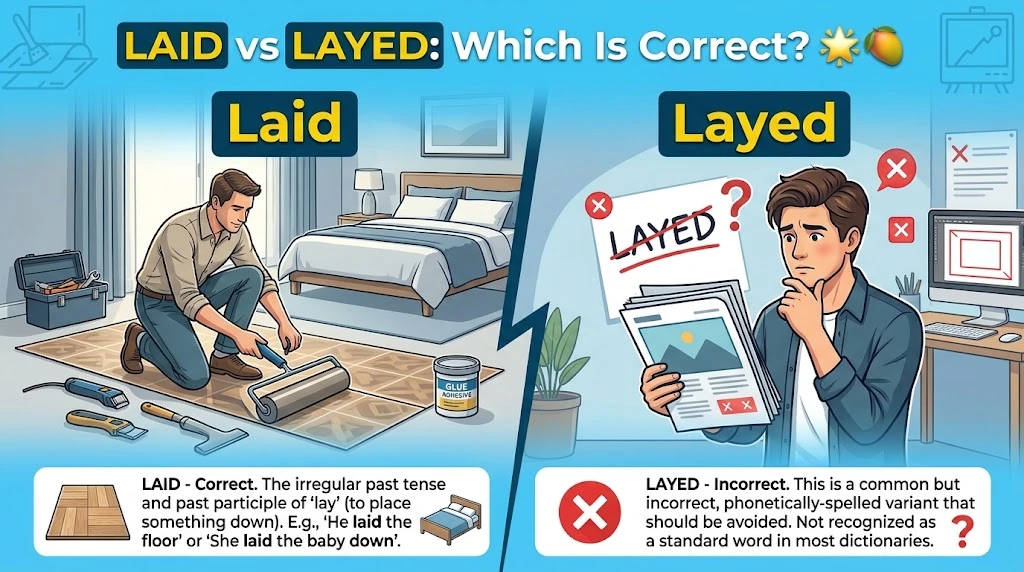
The Laid vs Layed spelling confusion affects English learners because many English verbs follow a simple “-ed” pattern, but laid is correct in standard English.
The laid vs layed question is a common grammar issue in casual writing and professional writing. Although “layed” may appear in specialized or technical contexts, it is not the standard past tense or past participle of lay in ordinary English. The correct spelling is laid, meaning to put something down or place something down. Understanding the difference between lay and lie helps
improve writing clarity, writing accuracy, and grammatical correctness in modern English, everyday writing, and written English. These spelling rules apply to American English and British English, including formal communication, academic writing, business contexts, and industry-specific contexts. Learning verb conjugation, word forms, and correct verb usage helps language learners avoid repeated mistakes, spelling confusion, and common errors.
A quick object test is a helpful grammar tip for deciding which word to use and when to use it. If someone placed something, use lay, laying, or laid; these are forms of a transitive verb that takes a direct object. For example, “She laid the book on the desk.” If the subject rested, use lie, lying, lay, or lain, depending on the tense. For example, “He lay on the sofa yesterday.” These example sentences show the differences between words and explain how to use them correctly in spoken English, emails, school assignments,
sentence writing, and business communication. Instead of trying to memorize a long chart of confusing verb forms, focus on verb selection, sentence structure, present participle forms, and past forms. This simple rule supports language learning, grammar learning, grammar knowledge, language skills, and English vocabulary. With regular practice, you can choose the correct word for formal writing, informal writing, and clear sentences while improving sentence clarity, accurate writing, and professional communication.
Laid vs Layed: The Simple Definition

The easiest answer is:
Laid is the correct past tense and past participle of lay. Layed is normally incorrect when used as the past form of lay.
The verb lay means to put or place something somewhere.
Its main forms are:
| Verb Form | Correct Form | Example |
| Base form | lay | I lay the book down. |
| Past tense | laid | I laid the book down. |
| Past participle | laid | I have laid the book down. |
| -ing form | laying | I am laying the book down. |
Therefore, the standard forms are lay → laid → laid → laying.
The spelling layed should not normally be used for these forms.
Sentence Structure of Laid
Understanding sentence structure helps you use laid correctly.
The verb lay is normally a transitive verb, which means it usually needs a direct object. You lay something somewhere.
A basic pattern is:
Subject + laid + object + place
Examples:
- She laid the keys on the table.
- He laid the jacket on the chair.
- I laid the papers beside the computer.
- They laid the flowers on the grave.
Notice that the object comes after laid.
For example:
She laid the book on the desk.
- She = subject
- laid = verb
- the book = direct object
- on the desk = place phrase
This structure is important because lay and lie are different verbs.
Rules for Using Laid Correctly
There are several useful rules to remember when choosing laid.
Rule 1: Use Laid as the Past Form of Lay
When an action happened in the past, use laid.
- Present: I lay the clothes on the bed.
- Past: I laid the clothes on the bed.
Rule 2: Use Laid After Have, Has, or Had
Because laid is also the past participle, it follows helping verbs such as have, has, and had.
Examples:
- I have laid the book here.
- She has laid the papers on the desk.
- They had laid the foundation before winter.
This is where understanding the use of had becomes useful.
Rule 3: Use Laying for the -ing Form
The continuous form is laying, not laying with an additional unnecessary letter and not layed.
- She is laying the baby down.
- He was laying the tools on the floor.
Examples of Laid in Everyday English
Here are several real-life examples showing the correct use of laid.
Everyday Examples
- I laid my phone on the table.
- She laid the baby gently in the crib.
- He laid his coat on the sofa.
- We laid the plates on the table.
- They laid flowers beside the monument.
- The worker laid the tiles carefully.
- She laid the documents in a folder.
- He laid the foundation for the building.
- I have laid everything you need on the desk.
- They had laid the groundwork for the project.
Read More;Bailer vs Baler: What’s the Difference and Which Word Is Correct
Negative Sentences
The same verb form can appear in negative sentences.
- I did not lay the book there.
- She did not lay the clothes on the bed.
- They had not laid the foundation correctly.
Notice the difference:
Did + base verb:
She did not lay the book down.
Had + past participle:
She had not laid the book down.
Common Mistakes With Laid and Layed
The most common mistake is writing layed as the past tense of lay.
Incorrect
I layed the book on the table.
Correct
I laid the book on the table.
Another mistake happens when learners confuse lay with lie.
Compare these forms:
| Meaning | Present | Past | Past Participle |
| Put something down | lay | laid | laid |
| Rest/recline | lie | lay | lain |
For example:
- I lay the baby down. → I laid the baby down yesterday.
- I lie on the sofa. → I lay on the sofa yesterday.
This difference causes many errors because lay can itself be the past tense of lie.
Laid vs Layed Comparison Table
The following table gives you a quick comparison.
| Feature | Laid | Layed |
| Standard English | Yes | Generally no |
| Past tense of lay | Yes | No |
| Past participle of lay | Yes | No |
| Meaning | Put or placed something | Usually a misspelling |
| Example | She laid the book down. | She layed the book down. ❌ |
| -ing form | Laying | Not layed |
| Recommended in formal writing | Yes | No |
So, when you mean the past form of lay, choose laid.
Laid, Lay, Lie, and Laying: Verb Usage
The verb family can seem confusing because lay and lie have overlapping forms.
Here is a useful chart:
| Verb | Present | Past | Past Participle | -ing Form |
| Put/place | lay | laid | laid | laying |
| Rest/recline | lie | lay | lain | lying |
Examples:
Lay:
- I lay the book on the desk.
- I laid the book on the desk yesterday.
- I have laid the book on the desk.
- I am laying the book on the desk.
Lie:
- I lie on the bed.
- I lay on the bed yesterday.
- I have lain on the bed.
- I am lying on the bed.
The important point is that laid belongs to the verb lay, while lay can also be the past tense of lie.
Laid and English Tenses
The correct verb form depends on the tense and sentence structure.
Simple Present
Use lay for a regular present action.
I lay the papers on the desk every morning.
Simple Past
Use laid for a completed past action.
I laid the papers on the desk yesterday.
Present Perfect
Use have/has + laid.
She has laid the documents on the table.
Past Perfect
Use had + laid.
She had laid the documents on the table before the meeting started.
Future
Use will + lay.
I will lay the books on the desk tomorrow.
This demonstrates an important grammar principle: after will, use the base form of the verb.
Understanding these patterns is more useful than memorizing isolated words. The same principle applies when studying other grammar topics such as has vs have, future indefinite tense examples, and other verb forms.
Clauses and Grammar Patterns With Laid
The word laid can appear in different types of clauses and sentence patterns.
Simple Clause
She laid the keys on the table.
Compound Sentence
She laid the keys on the table, and I picked them up.
Complex Sentence
After she laid the keys on the table, she left the room.
With a Time Clause
When he laid the papers down, everyone became quiet.
The verb can therefore work naturally in independent and dependent clauses.
A useful pattern is:
Subject + laid + object + complement/place
For example:
The teacher laid the books on the desk.
Learning these patterns makes it easier to understand how verbs, clauses, and sentence structure work together.
Laid vs Layed: Quick Memory Trick
A simple memory trick can help you remember the correct spelling.
Think:
Lay → Laid → Laid
The verb lay does not become layed in standard English.
Remember these three forms:
Today: I lay the book down.
Yesterday: I laid the book down.
Already: I have laid the book down.
For the continuous form, use:
I am laying the book down.
If you remember lay, laid, laid, laying, you will avoid most mistakes involving this verb.
Also remember that grammar topics do not always follow the same pattern. For example, some learners search for rules involving 10 examples of adjective, has vs have, or the use of had, but laid is primarily a question of irregular verb forms.
Conclusion
Understanding Laid vs Layed is important for improving your English grammar and writing accuracy. Laid is the correct past tense and past participle of lay, while layed is considered a spelling error in standard English. Remember that lay means to put or place something down, whereas lie means to rest or recline. Learning these verb forms and practicing with simple example sentences can help you avoid common grammar mistakes in academic writing, professional communication, emails, and everyday conversations. When you are unsure, check whether the verb takes a direct object to choose the correct form.
Frequently Asked Questions (FAQs)
1. Is it laid or layed?
Laid is the correct spelling in standard English. Layed is generally considered incorrect when used as the past tense of lay.
2. What is the past tense of lay?
The past tense of lay is laid. For example: “She laid her phone on the table.”
3. Is layed ever correct?
In ordinary modern English, layed is not the standard form of lay. Use laid in everyday, academic, and professional writing.
4. What is the difference between lay and lie?
Lay means to put or place something down and usually takes an object. Lie means to rest or recline and does not take a direct object in this sense.
- Lay: I lay the book on the desk.
- Lie: I lie on the sofa.
5. What is the past tense of lie?
When lie means to rest or recline, its past tense is lay. For example: “Yesterday, I lay on the sofa.”
6. What is the past participle of lay?
The past participle of lay is laid. For example: “She has laid the keys on the counter.”
7. Do American and British English use laid?
Yes. Laid is the standard form in both American and British English.
8. How can I remember the difference between laid and layed?
Remember this simple rule: laid is correct; layed is not the standard spelling. Practice sentences such as “He laid the bag on the floor” to remember the correct form.