Understanding Loosing vs Losing helps you choose the right spelling when you describe misplacing something, failing, or setting something free. In everyday online writing, especially on social media, a writer may make a
typo, typing error, or spelling mistake because of confusion between these commonly confused words. For example, writing “I’m loosing my mind” instead of “I’m losing my mind” is generally an unintended error, not
an intentional use of internet slang or an internet protocol. Although this grammatical error might trigger a pedantic person, understanding standard English and English grammar helps readers recognize the correct spelling. Losing is a verb that describes failing to win, failing to hold onto something, misplacing something, or being defeated, such as
when you lose a game, lose one’s temper, or experience losing something. In contrast, loose is an adjective meaning not securely attached, but it can also function as a verb meaning to free something, free someone, loosen, release, or untie something. Loosing is a real word,
although it is an uncommon word used for releasing, untying, or setting something free. These word meanings, parts of speech, and grammatical functions explain the main spelling differences and improve word choice and word usage.
Simple mnemonics and memory tricks can make these word definitions easier to remember. A grammar expert from the Grammarly Answers website shares a useful learning trick: remove the extra O from loose, and you get lose, which is the opposite of find. This spelling mnemonic is particularly helpful for visual learners who can picture two ropes side by
side. Think of loose as a longer rope than lose because it has an extra letter and another O. Therefore, loose is longer, lose is shorter, and loose is looser than lose. Remembering this comparison also makes correct usage easier and helps distinguish verb usage, adjective usage, noun usage, and
adverb usage. Regular proofreading of written communication can identify incorrect spelling and prevent unnecessary grammar mistakes. Learning the vocabulary, meanings, and correct word choice associated with lose vs loose helps people communicate clearly in the English language.
Definition of Loosing vs Losing
What Does Losing Mean?
Losing is the -ing form of the verb “lose.” It means failing to keep something, being unable to find something, or being defeated in a competition.
Examples include:
- I am losing my patience.
- She is losing her phone.
- Our team is losing the match.
- He is losing interest in the project.
- They are losing money.
The word lose can describe many situations involving something being taken away, misplaced, forgotten, or not won.
Read More;Programming vs Programing: Which Spelling Is Correct
What Does Loosing Mean?
Loosing is the -ing form of the verb “loose.” The verb loose means to release, set free, or let something move freely.
For example:
- The farmer is loosing the animals from the enclosure.
- The prisoner was loosing the ropes.
- She is loosing the birds from their cage.
Because loosing is relatively uncommon in modern everyday English, learners often mistakenly use it instead of losing.
Sentence Structure of Losing and Loosing
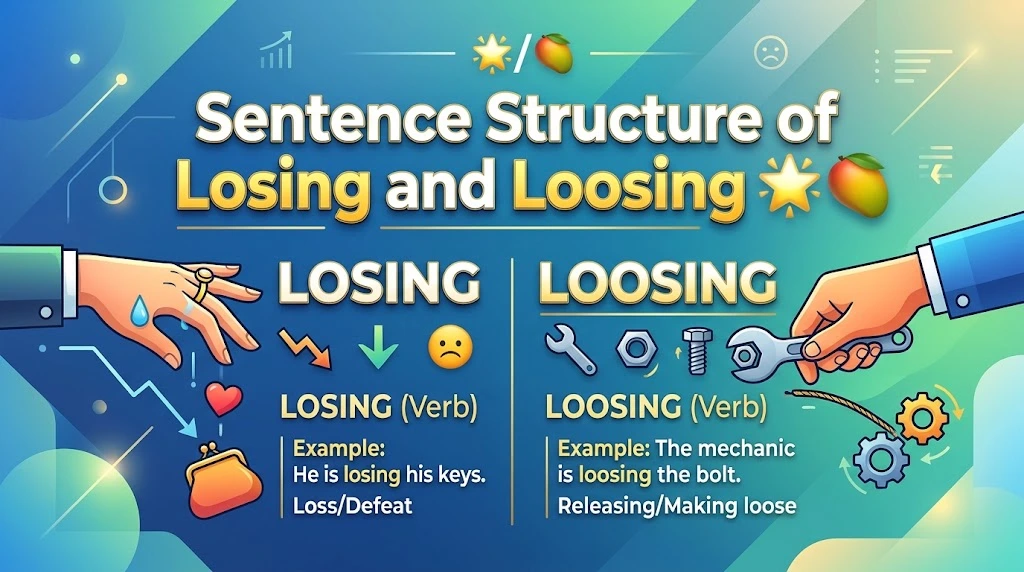
Understanding the sentence structure makes the difference easier to remember. Both losing and loosing can work as present participles or gerunds, depending on how they are used.
A common structure with losing is:
Subject + be verb + losing + object
Examples:
- I am losing my keys.
- She is losing confidence.
- They are losing the game.
A common structure with loosing is:
Subject + be verb + loosing + object
Examples:
- He is loosing the animals.
- The keeper is loosing the birds.
The important point is that the meaning of the sentence changes because lose and loose are different verbs.
Rules for Using Losing
Follow these simple rules when using losing:
- Use losing when something is being misplaced.
- I am losing my wallet.
- Use losing when someone is being defeated.
- Our team is losing the match.
- Use losing when someone is gradually experiencing a reduction.
- She is losing weight.
- Use losing when someone no longer has something.
- He is losing interest.
- Use losing after helping verbs such as am, is, and are when forming the present continuous tense.
- They are losing time.
Rules for Using Loosing
Use loosing only when the intended meaning comes from the verb loose, meaning release or set free.
For example:
- The trainer is loosing the dogs.
- The sailor is loosing the rope.
- They are loosing the animals.
In ordinary conversations, you will rarely need loosing. The word loosening is often used when the intended meaning is “making something less tight.”
Examples of Loosing vs Losing
Here are several practical examples to make the difference clear.
Examples of Losing
- I am losing my keys again.
- She is losing her confidence.
- We are losing the competition.
- He is losing his patience.
- They are losing valuable time.
- The company is losing customers.
- My phone keeps losing its signal.
- The player is losing the match.
Examples of Loosing
- The farmer is loosing the horses.
- The keeper is loosing the birds.
- He is loosing the animals from the cage.
- The guard is loosing the prisoners from their restraints.
Quick tip: If you mean misplacing, failing, or not winning, use losing. If you mean releasing or setting free, loosing may be correct.
Common Mistakes with Loosing and Losing
One of the most common mistakes is writing loosing when the intended word is losing.
Incorrect:
I am loosing my phone.
Correct:
I am losing my phone.
Here, the meaning is that the person cannot keep or find the phone, so losing is correct.
Another common mistake is:
Incorrect:
Our team is loosing the game.
Correct:
Our team is losing the game.
A useful memory trick is to connect lose → losing and loose → loosing.
Also remember that loose, loosen, and lose are separate words. A loose shirt is not tight, while to loosen something means to make it less tight.
Loosing vs Losing Comparison Table
| Word | Base Verb | Meaning | Common Use | Example |
| Losing | Lose | Failing to keep, find, or win something | Very common | I am losing my keys. |
| Loosing | Loose | Releasing or setting free | Uncommon | He is loosing the horses. |
| Loose | Loose | Not tight | Adjective | My shirt is loose. |
| Loosen | Loosen | Make less tight | Verb | Please loosen the knot. |
This comparison also shows why spelling matters. Changing one letter can change the meaning, word class, and sentence usage.
Verb Usage and Forms
The word losing comes from the irregular verb lose.
Its basic forms are:
| Verb Form | Word |
| Base form | lose |
| Past tense | lost |
| Past participle | lost |
| Present participle | losing |
Examples:
- I often lose my keys.
- I lost my keys yesterday.
- I have lost my keys.
- I am losing my keys again.
The verb loose is different. Its forms can include loose, loosed, and loosing. However, loose is much less commonly used as a verb in modern everyday English than lose.
Losing in Different Tenses
Losing is especially common with continuous tenses because it is the present participle of lose.
Present Continuous
Subject + am/is/are + losing
- I am losing weight.
- She is losing patience.
- They are losing the match.
Past Continuous
Subject + was/were + losing
- I was losing my concentration.
- They were losing the game.
Future Continuous
Subject + will be + losing
- The team will be losing players if conditions do not improve.
Learning these patterns can also help students understand other grammar topics, including future indefinite tense examples, because both involve understanding the correct auxiliary verbs and verb forms.
Clauses and Grammar Usage
Losing can appear in different types of clauses and sentence patterns.
For example:
- When I was losing hope, my friend helped me.
- I became worried because I was losing time.
- Although they were losing the match, they continued playing.
Here, the word losing is part of a larger clause. The meaning remains connected to the verb lose.
You can also use losing as a gerund:
Losing the competition taught him an important lesson.
In this sentence, losing the competition acts as the subject of the sentence.
This is similar to other grammar topics involving verbs, clauses, and sentence structure.
How to Remember the Difference
A simple memory trick can prevent most spelling mistakes.
Remember: Lose → Losing
When you mean not keeping, not finding, or not winning, choose losing.
Lose → Losing
- lose a game → losing a game
- lose money → losing money
- lose a phone → losing a phone
- lose patience → losing patience
Remember: Loose → Loosing
When you mean release or set free, the verb is loose, and its -ing form is loosing.
Loose → Loosing
However, because loosing is uncommon, check whether loosening is actually the word you need when you mean “making something less tight.”
Conclusion
Understanding the difference between loosing and losing helps you avoid common English spelling mistakes. Remember that losing means failing to win, misplacing something, or no longer having something, while loosing means releasing, untying, or setting something free. Although both are real words, losing is the correct choice in most everyday situations. A simple trick is to remember that loose has an extra O, while lose has only one. With regular reading and proofreading, you can use these words correctly and improve your English writing.
Frequently Asked Questions (FAQs)
1. Is it loosing or losing?
Losing is correct when describing failure, defeat, or misplacing something. Loosing means releasing or setting something free.
2. Is loosing a real English word?
Yes, loosing is a real but uncommon word. It is the present participle of loose, meaning releasing or setting something free.
3. Why do people confuse loose and lose?
People confuse these words because their spellings are similar. The extra O in loose often causes spelling confusion.
4. What does losing mean?
Losing means failing to win, misplacing something, or no longer keeping something. For example: “I am losing my keys.”
5. What is an easy trick to remember loose vs lose?
Remember that loose has an extra O, just like a longer or looser rope. Lose has one O and means the opposite of find.