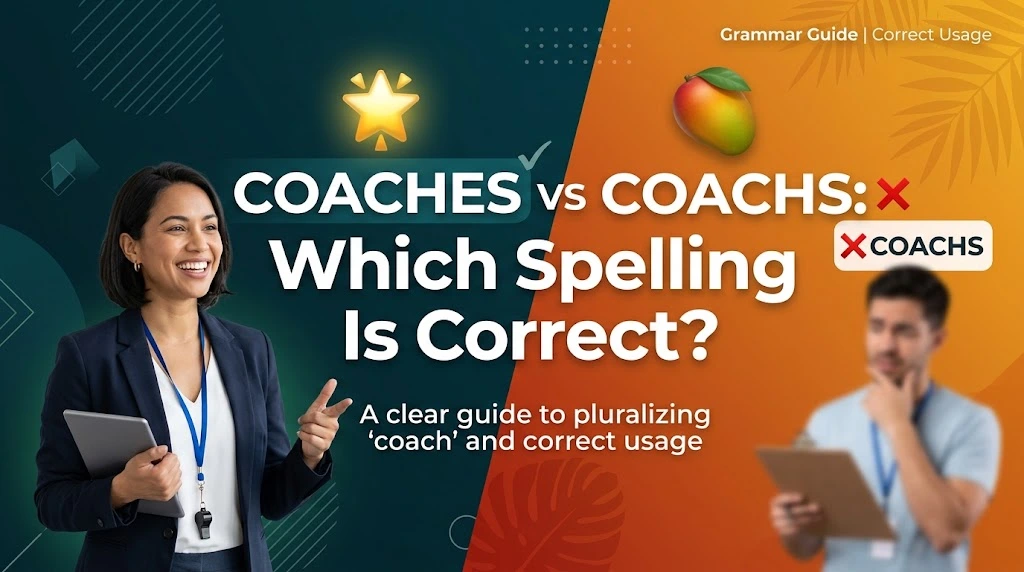
Coaches vs Coachs is a common English grammar question that can cause spelling mistakes in everyday writing, especially when discussing sports teams and their leadership. The correct plural form of coach is coaches, not coachs, and understanding this difference helps improve written
communication. In English grammar, an apostrophe changes the meaning of a sentence by showing ownership. For example, “coaches’ strategies are amazing” describes strategies belonging to multiple coaches, while “the coach’s whistle blew” refers to one coach. Learning possessive forms, sentence structure, apostrophe placement, and standard English grammar rules makes it easier for English learners to write clearly and use punctuation correctly.
These rules are also useful when preparing track banquet invitations for a high school track team or collecting money for coaches’ gifts. For example, We are collecting money for the coaches’ gifts” correctly shows that the
gifts are intended for multiple coaches. In contrast, “coach’s gifts” usually refers to one coach, while “coaches gifts” is missing the apostrophe needed to show possession. Understanding plural nouns, singular nouns, fundraising,
and possessive apostrophe rules helps prevent common mistakes in a player development report, coaching seminar, or sports banquet invitation. With practice, you can improve your professional communication, write correctly, and explain the difference between coach’s and coaches’ without confusion.
Coaches vs Coachs: The Correct Spelling
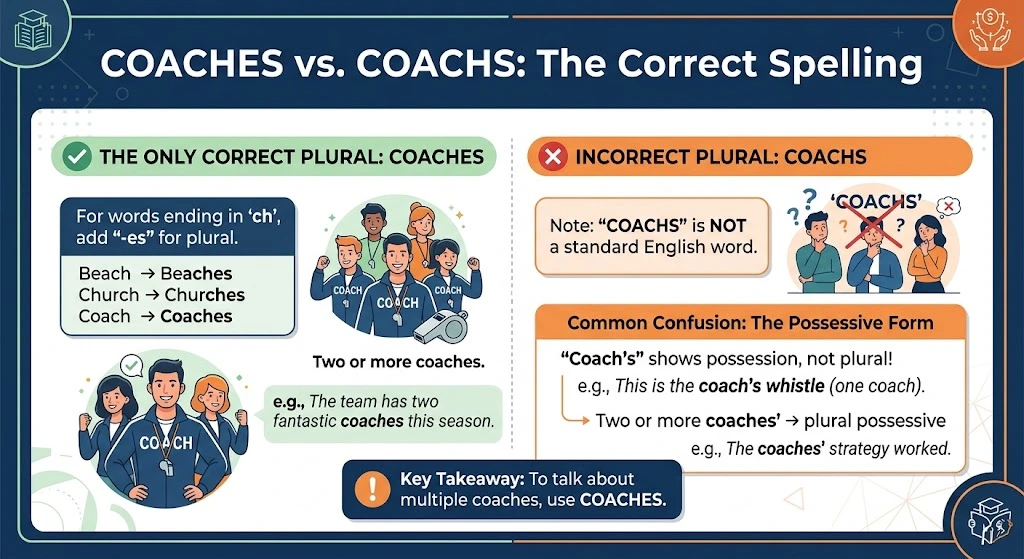
The correct spelling is coaches.
Coaches is the plural form of the noun coach. The spelling coachs is not considered correct in standard English.
| Word | Correct? | Meaning |
| Coach | ✅ Yes | One coach |
| Coaches | ✅ Yes | More than one coach |
| Coachs | ❌ No | Incorrect plural spelling |
The reason is simple: nouns ending in -ch commonly form their plural by adding -es, not simply -s.
Therefore:
coach + es = coaches
Not:
coach + s = coachs
What Does Coach Mean?
The word coach can be used as both a noun and a verb.
As a noun, a coach is usually someone who trains, teaches, or guides a person or group.
Examples:
- The football coach trained the players.
- Our basketball coach is very experienced.
- She became a tennis coach.
As a verb, coach means to train, teach, or help someone improve a skill.
Examples:
- He coaches young athletes.
- She coached the school team.
- They are coaching new players.
The word can also refer to a type of passenger vehicle, especially in British English.
Why Is Coaches the Correct Plural?
English has several rules for forming plural nouns. Most nouns simply take -s, such as:
- book → books
- car → cars
- teacher → teachers
However, some nouns take -es because their endings require an extra syllable for easier pronunciation.
Words ending in -ch are commonly included in this group:
- coach → coaches
- church → churches
- branch → branches
- lunch → lunches
- bench → benches
So, the spelling rule is:
Noun ending in -ch + -es = plural noun
That is why coaches is correct.
Sentence Structure With Coaches
The word coaches can appear in several common sentence structures.
Subject + Verb + Object
The coaches trained the players.
Here:
- The coaches = subject
- trained = verb
- the players = object
Subject + Verb
The coaches arrived early.
Here, the coaches is the subject and arrived is the verb.
Subject + Verb + Complement
The coaches are experienced.
In this sentence, experienced describes the coaches.
Understanding these patterns makes it easier to use coaches naturally in everyday English.
Read More;Ingange vs Engage: Which Spelling Is Correct
Coaches as a Noun and Verb
Coaches has two important grammatical uses.
First, it can be the plural noun of coach.
Example:
The coaches discussed the match.
Second, it can be the third-person singular present-tense verb.
Example:
He coaches the school team.
This distinction depends on the sentence.
| Use | Example |
| Plural noun | The coaches arrived. |
| Verb | She coaches children. |
The surrounding words usually make the meaning clear.
Examples of Coaches in Everyday English
Here are several natural examples using coaches:
- The coaches prepared the team for the final match.
- Three coaches attended the meeting.
- The football coaches gave the players new instructions.
- Our school has two experienced coaches.
- The coaches were proud of their players.
- Several coaches watched the competition.
- The university hired new coaches this year.
- Good coaches help players develop confidence.
- The coaches are planning tomorrow’s training session.
- She coaches young swimmers every weekend.
Notice that coaches can refer to more than one person or describe an action performed by he, she, or it.
Common Mistakes With Coaches and Coachs
The most common mistake is adding -s directly to coach.
❌ The school hired two coachs.
✅ The school hired two coaches.
Another common mistake occurs when learners confuse the plural noun with the verb.
❌ She coaches are excellent.
✅ Her coaches are excellent.
Here, coaches is a plural noun, so it needs a possessive determiner such as her.
Remember these simple examples:
- One coach
- Two coaches
- He coaches
- They coach
- She coached
- They coached
These patterns make the difference easier to remember.
Coaches vs Coachs Comparison Table
The following table gives a quick comparison.
| Feature | Coaches | Coachs |
| Correct spelling | ✅ Yes | ❌ No |
| Standard English | ✅ Yes | ❌ No |
| Plural of coach | ✅ Yes | ❌ No |
| Can be a verb | ✅ Yes | ❌ No in this spelling |
| Example | The coaches arrived. | The coachs arrived. ❌ |
The key point is that coaches is the only standard spelling for the plural of coach.
Verb Forms, Tenses, and Coaches
Because coaches can also function as a verb, it is useful to understand its connection with verbs and tenses.
The basic verb is coach.
| Tense/Form | Example |
| Base form | They coach the team. |
| Third-person singular | She coaches the team. |
| Past tense | She coached the team. |
| Present participle | She is coaching the team. |
| Past participle | She has coached the team before. |
This also shows why the ending matters.
In the simple present, he, she, and it usually require -s or -es:
She coaches the team.
However, with plural subjects such as they and the coaches, the base verb is normally used:
The coaches coach the players.
This is an important connection between spelling and tenses.
Coaches in Clauses and Different Sentence Patterns
The word coaches can be used in independent and dependent clauses.
Independent Clause
The coaches arrived early.
This is a complete thought.
With a Dependent Clause
The coaches arrived early because they wanted to prepare the field.
The first part is an independent clause, while because they wanted to prepare the field is a dependent clause.
Relative Clause
The coaches who trained the team received awards.
The phrase who trained the team gives additional information about the coaches.
Using coaches in different clauses helps learners develop stronger sentence structure and more natural writing.
Related Grammar Rules and Useful Comparisons
Learning coaches vs coachs can also help you understand other English spelling patterns.
Words ending in -s, -sh, -ch, -x, and -z often form plurals with -es.
Examples include:
- bus → buses
- dish → dishes
- church → churches
- box → boxes
- quiz → quizzes
However, English has exceptions and spelling changes, so learners should not apply one rule blindly to every noun.
You may also encounter other grammar topics while learning plural nouns, such as has vs have, the use of had, 10 examples of adjective, future indefinite tense examples, verbs, sentence structure, tenses, and clauses. These topics are separate from the spelling of coaches, but understanding them helps build a stronger overall foundation in English grammar.
Conclusion
Understanding Coaches vs Coachs helps you improve your spelling and English grammar. Remember that coaches is the correct plural form of coach, while coachs is incorrect. Use coach’s to show possession by one coach and coaches’ to show possession by multiple coaches. For example, “the coach’s whistle” refers to one coach, while “the coaches’ gifts” refers to gifts for several coaches. By learning these simple apostrophe rules, you can write clearly and avoid common grammar mistakes in school assignments, sports invitations, and professional communication.
Frequently Asked Questions (FAQs)
1. Is it coaches or coachs?
Coaches is correct. Coachs is an incorrect spelling of the plural form of coach.
2. What is the plural form of coach?
The plural form is coaches. For example, “The coaches help the players improve their skills.”
3. Is it coach’s or coaches’?
Coach’s shows possession by one coach, while coaches’ shows possession by multiple coaches.
4. Should I write coaches’ gifts or coaches gifts?
Write coaches’ gifts when referring to gifts for multiple coaches. The apostrophe after the s indicates plural possession.
5. How do you use coach’s in a sentence?
Example: “The coach’s whistle was loud.” The apostrophe before the s shows that the whistle belongs to one coach.
6. Why does coaches’ have an apostrophe after the s?
Because coaches is already plural, the apostrophe is placed after the final s to show ownership by multiple coaches.
7. Is coaches a singular or plural noun?
Coaches is a plural noun. The singular form is coach.
8. What is the difference between coaches and coaches’?
Coaches refers to more than one coach, while coaches’ indicates that something belongs to multiple coaches.