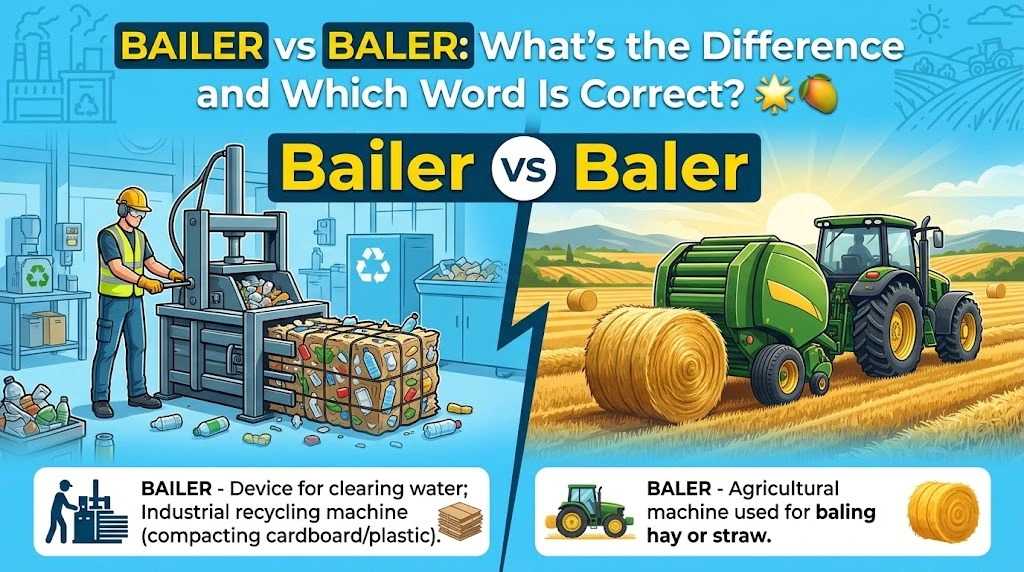
Bailer vs Baler can be confusing because these words sound similar but have different meanings and uses in different industries. A baler machine is agricultural equipment used in farming and recycling machinery to compress hay, straw, cardboard, paper, plastic, and other recyclable
materials into compact bundles called bales. These compressed materials are easier to manage during storage and transport and support waste management. Hay bundles, straw bales, cardboard bundles, paper bundles, and plastic bundles are common examples. Understanding the correct
meanings, technical terminology, and industry usage helps English learners improve vocabulary, spelling accuracy, and professional communication. Character count for the keyword sentence: 146 characters, including spaces and punctuation.
A bailer, by contrast, is a person, tool, or device used for water removal from a boat, canoe, or container. It may also be used to collect water from a groundwater well for groundwater sampling. In legal contexts, bail relates to the release of an accused person under specified conditions, although bailer
is not the usual term for someone who provides bail in standard legal English. An easy memory technique is bale → baler and bail → bailer. This spelling pattern helps you choose the right word based on sentence context, word formation, and meaning. Using practical examples
and correct word usage reduces spelling mistakes in everyday writing and technical writing while improving grammar accuracy, proper terminology, and confidence when discussing agricultural machinery, recycling equipment, or water-removal tools.
Bailer vs Baler: Simple Definitions
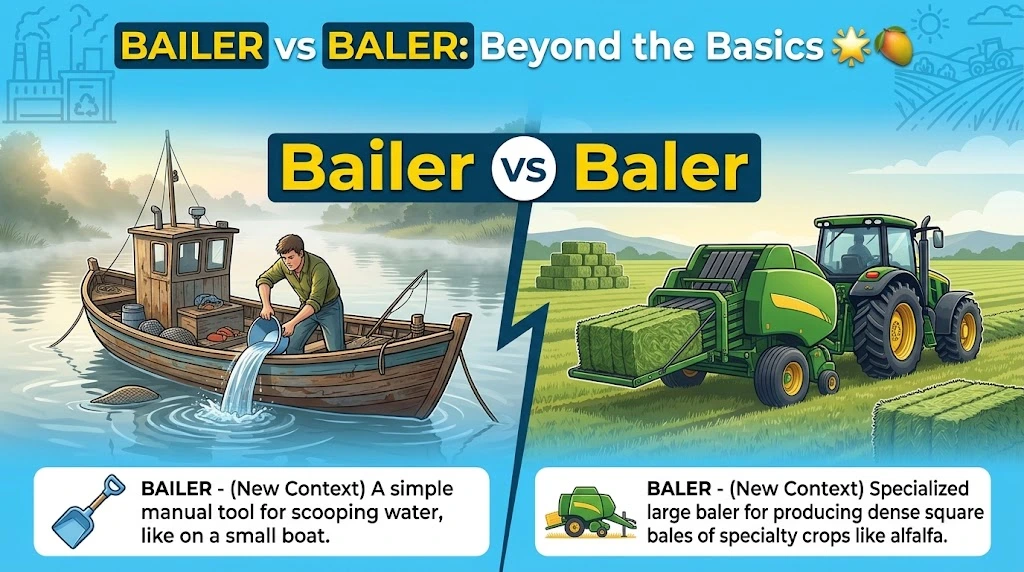
The easiest way to understand these words is to look at their definitions.
What Does Bailer Mean?
Bailer is a noun formed from the verb bail. It can describe a person or device that removes water from a boat or another area.
For example:
The sailor used a bailer to remove water from the boat.
The word can also refer to a person who provides bail for someone who has been arrested or charged with a crime.
The defendant’s brother acted as his bailer.
Therefore, the exact meaning depends on the context.
What Does Baler Mean?
Baler is a noun formed from the verb bale. It usually means a machine that compresses and ties materials into bales.
For example:
The farmer used a baler to collect the hay.
A baler can be used for hay, straw, cotton, recycling materials, cardboard, paper, and other products.
Quick Difference
| Word | Meaning | Related Verb | Example |
| Bailer | A person or device that bails | Bail | The sailor grabbed the bailer. |
| Baler | A machine or person that makes bales | Bale | The farmer repaired the baler. |
Bailer and Baler Sentence Structure
Both bailer and baler are generally nouns, so they commonly appear as the subject or object of a sentence.
A basic sentence structure is:
Subject + verb + object
For example:
The baler compressed the hay.
Here, baler is the subject, compressed is the verb, and hay is the object.
Another structure is:
Subject + verb + noun
The bailer is useful.
The sentence structure does not change simply because you use one spelling instead of the other. The important point is to choose the noun that matches the intended meaning.
Examples of Sentence Patterns
- The baler is working in the field.
- The sailor used a bailer.
- We purchased a new baler.
- The bailer removed water from the boat.
- The farmer repaired the broken baler.
Bailer: Meaning, Uses, and Examples
The word bailer comes from bail, which has several meanings.
One important meaning of bail is to remove water from a boat or another container.
In this sense, a bailer is a person or tool used for that purpose.
Bailer in Boating
A small boat may take on water. A person can use a bailer to remove that water.
Examples:
- The fisherman picked up the bailer.
- We need a bailer because water is entering the boat.
- The sailor used a plastic bailer to remove the water.
- Keep the bailer near the side of the boat.
- The old boat did not have a proper bailer.
Bailer in Legal Contexts
The word can also be connected with bail in the legal system.
A bailer may refer to a person who provides bail for another person, although terminology can vary depending on the legal system.
For example:
His uncle agreed to act as the bailer.
However, in many legal contexts, terms such as surety, bail guarantor, or bailor may be more appropriate.
Baler: Meaning, Uses, and Examples
A baler is most commonly a machine that compresses material into compact bundles called bales.
Balers are especially common in agriculture, recycling, manufacturing, and waste management.
Baler in Agriculture
Farmers commonly use balers to collect and compress hay or straw.
Examples:
- The farmer bought a new baler.
- The baler turned the hay into large rectangular bales.
- We need to repair the baler before harvest.
- The tractor pulled the baler across the field.
- The old baler stopped working yesterday.
Baler in Recycling
Industrial balers can compress:
- cardboard
- paper
- plastic
- cotton
- textiles
- recyclable materials
For example:
The recycling center uses a large baler to compress cardboard.
Thus, when you are talking about a machine that creates bales, baler is the correct word.
Bailer vs Baler: Comparison Table
The following table makes the difference easy to remember.
| Feature | Bailer | Baler |
| Part of speech | Noun | Noun |
| Related verb | Bail | Bale |
| Main meaning | Person or tool that bails | Person or machine that makes bales |
| Common field | Boating, legal contexts | Farming, recycling, industry |
| Related noun | Bail | Bale |
| Example | The boat needs a bailer. | The farm needs a baler. |
| Main action | Removing water or providing bail | Compressing material into bales |
The simplest memory trick is:
Bailer → bail → remove water
Baler → bale → make a bale
Common Mistakes with Bailer and Baler
Because the words differ by only one letter, learners often use them incorrectly.
Mistake 1: Using Baler for Removing Water
Incorrect:
The sailor used a baler to remove water.
Correct:
The sailor used a bailer to remove water.
The correct word is bailer because the action is bailing water.
Mistake 2: Using Bailer for a Hay Machine
Incorrect:
The farmer bought a new bailer for the hay.
Correct:
The farmer bought a new baler for the hay.
A machine that makes hay bales is a baler.
Mistake 3: Confusing Bale and Bail
Remember that bale and bail are different verbs.
- Bail → remove water or provide temporary release from custody
- Bale → bundle or compress material into a bale
Therefore:
The sailor bailed the boat.
But:
The farmer baled the hay.
Mistake 4: Assuming Similar Spelling Means Similar Meaning
English has many words that look similar but have different meanings. Bailer and baler are a good example.
Always consider the context before choosing the spelling.
Bailer vs Baler: Verb Usage and Word Forms
Understanding the related verbs makes the difference much easier.
Bail
The verb bail can mean to remove water.
Examples:
We need to bail the boat.
She bailed the water out of the canoe.
They are bailing the boat.
Common forms include:
- bail
- bails
- bailed
- bailing
The noun bailer is related to this verb.
Bale
The verb bale means to gather, compress, and package material into a bale.
Examples:
Farmers bale hay after it dries.
They baled the straw yesterday.
The machine is baling cotton.
Common forms include:
- bale
- bales
- baled
- baling
The noun baler comes from this verb.
Read More;Coaches vs Coachs: Which Spelling Is Correct
Easy Rule
Bail → bailer
Bale → baler
This simple connection can prevent most spelling mistakes.
Bailer vs Baler in Different Tenses
Although bailer and baler are nouns, their related verbs can be used with different tenses.
Understanding tenses helps you build accurate sentences around these words.
Present Simple
The sailor bails the boat.
The farmer uses a baler.
Past Simple
The sailor bailed the boat.
The farmer used a baler yesterday.
Present Continuous
The sailor is bailing the boat.
The farmer is using the baler.
Future
The sailor will bail the boat.
The farmer will use the baler tomorrow.
These examples show why learning the related verbs is useful.
The same principle applies when studying other grammar topics such as the use of had, has vs have, and future indefinite tense examples.
Bailer vs Baler in Clauses and Grammar Usage
Both words can appear in different types of clauses and sentence patterns.
A noun can be used in an independent clause:
The baler is broken.
It can also appear in a dependent clause:
When the baler stopped working, the farmer called a mechanic.
Here, “When the baler stopped working” is a dependent clause.
More Clause Examples
- Because the baler was broken, the farmer stopped working.
- The sailor continued working while the bailer removed the water.
- After the farmer repaired the baler, he returned to the field.
- The sailor knew that the bailer was missing.
Learning these patterns can improve overall sentence structure.
It is also useful to remember that bailer and baler are nouns, while bail and bale are verbs. Knowing the role of each word makes sentence construction easier.
More Real-Life Examples of Bailer vs Baler
Here are practical examples to help you remember the difference.
Examples with Bailer
- The sailor grabbed the bailer.
- We kept a bailer inside the small boat.
- The canoe filled with water, so we needed a bailer.
- He used the bailer to remove water.
- The boat’s bailer was damaged.
- The sailor carried an emergency bailer.
- The crew used a bailer during the storm.
Examples with Baler
- The farmer purchased a new baler.
- The baler compressed the dry hay.
- The tractor pulled the baler through the field.
- The farm’s baler needs maintenance.
- The recycling company installed a cardboard baler.
- The worker operated the industrial baler.
- The baler produced dozens of hay bales.
A Quick Memory Test
Ask yourself:
Is it related to bail?
Use bailer.
Is it related to bale?
Use baler.
This two-question test is often enough to choose the correct spelling.
Conclusion
In conclusion, Bailer vs Baler is an important word comparison because both words sound similar but have different meanings and uses. A baler is a machine that compresses materials such as hay, straw, cardboard, paper, and plastic into compact bundles called bales. A bailer, on the other hand, is a person or tool used to remove water from a boat, container, or other area. Remember that bale is connected to a baler, while bail is connected to a bailer. Understanding this simple difference will help you choose the correct word in writing and everyday communication.
FAQs
1. What is the main difference between Bailer and Baler?
A baler is a machine that compresses materials into bales, while a bailer is a person or tool that removes water from a boat or container.
2. Is Bailer a correct word?
Yes, bailer is a correct English word. It commonly refers to someone or something that removes water from a boat or another area.
3. What is a baler used for?
A baler is used in agriculture, recycling, and waste management to compress materials such as hay, straw, cardboard, paper, and plastic into compact bundles.
4. How can I remember the difference between Bailer and Baler?
Remember that baler comes from bale, meaning a compact bundle of material. Bailer comes from bail, which can refer to removing water from a boat or container.
5. Are Bailer and Baler pronounced the same?
In many English accents, bailer and baler are pronounced the same. However, their meanings and spellings are different, so you must use each word according to its context.
6. Which word should I use for a machine that compresses hay?
Use baler when referring to a machine that compresses hay, straw, or other materials into bales.