English spelling can sometimes be confusing, especially when two words look almost identical but have different levels of acceptance. Connector vs connecter is a good example of this confusion. Both spellings appear in written English, but one is much more widely accepted and commonly used than the other.
If you are unsure whether to write connector or connecter, you are not alone. Many English learners, students, and writers wonder which spelling is correct in formal writing, technical documents, and everyday communication.
The good news is that connector is the standard and preferred spelling in modern English. It refers to a person or thing that connects two or more things. Although connecter is occasionally found as an alternative spelling, it is uncommon and generally not recommended.
In this article, we will explain the meaning, spelling rules, sentence structure, examples, and grammatical differences between connector and connecter. You will also learn how related verbs, nouns, and English tenses work with these words.
Connector vs Connecter: Which One Is Correct?
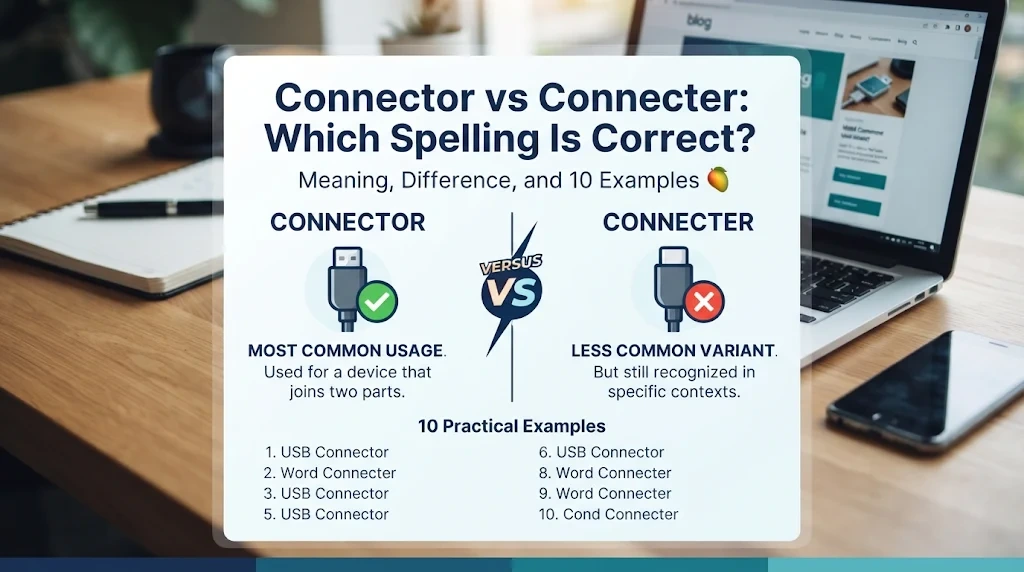
The correct and standard spelling is connector. It is the noun commonly used for something that joins, links, or connects two or more objects, systems, people, or ideas.
Connecter is a rare alternative spelling. However, it is not the usual choice in modern standard English, and most dictionaries, technical writers, and professional publications prefer connector.
For example:
- Correct: I need a new connector for my computer.
- Uncommon: I need a new connecter for my computer.
Therefore, if you are writing an email, school assignment, article, technical guide, or professional document, choose connector.
Definition of Connector and Connecter
Understanding the definitions of both spellings makes it easier to remember which one to use.
What Does Connector Mean?
Connector is a noun that describes a person, device, or object that joins two or more things together. It comes from the verb connect, which means to establish a link or relationship between separate things.
A connector can be physical or abstract. For instance, an electrical connector joins wires, while a person can act as a connector by introducing people to each other.
Examples include:
- A USB connector joins a cable to a computer.
- A sentence connector links ideas in a paragraph.
- A business connector introduces professionals to useful contacts.
- A pipe connector joins two sections of a water system.
What Does Connecter Mean?
Connecter is an uncommon spelling sometimes used to describe someone or something that connects. It follows a possible spelling pattern based on adding -er to a verb.
However, connector is the established spelling in standard modern English. Consequently, connecter should generally be avoided unless you are reproducing a specific historical spelling, name, or source.
Sentence Structure of Connector vs Connecter
Both words are intended to function as nouns, rather than verbs or adjectives. However, connector is the normal choice in everyday English.
A noun can appear in different positions within a sentence. It may function as a subject, direct object, or object of a preposition.
Here are some common sentence structures:
| Sentence structure | Example |
| Subject + verb | The connector works properly. |
| Article + noun | I bought a connector. |
| Adjective + noun | This electrical connector is damaged. |
| Verb + object | Please replace the connector. |
| Preposition + noun | The cable is attached to the connector. |
For example:
- The connector is missing.
- She purchased a new connector yesterday.
- We need a suitable connector for this device.
- The technician repaired the damaged connector.
These examples demonstrate how connector fits naturally into different sentence patterns.
Important Spelling Rules: Connector vs Connecter
English spelling rules can help explain why certain words use one spelling instead of another. However, English also contains exceptions that must be learned through regular reading and writing.
1. The Root Word Connect
The word connector comes from the verb connect.
The root word contains the letters C-O-N-N-E-C-T. When forming the established noun, English uses the spelling connector.
2. The Double Consonant Rule
In connector, the letter T is doubled before the ending -or.
This spelling is established through standard English usage. It is important to remember that not every noun formed from a verb follows exactly the same pattern.
3. The Suffix -Or
The suffix -or appears in many English nouns that describe people or things performing an action.
Examples include:
- Creator
- Operator
- Inventor
- Director
- Translator
- Connector
Therefore, connector follows a familiar English word-formation pattern.
4. Why Connecter Is Uncommon
Connecter uses the suffix -er, which is also common in English nouns.
For example, teacher comes from teach, and worker comes from work. However, this does not mean every verb can form its standard noun by simply adding -er.
For connect, the established noun is connector.
10 Examples of Connector in Sentences
The best way to understand a word is to see how people use it in everyday situations. Here are 10 examples showing the correct use of connector.
- I bought a new USB connector for my laptop.
- The electrical connector needs to be replaced.
- This cable has a damaged connector at one end.
- A good communication connector helps people share ideas.
- The plumber installed a new pipe connector.
- Make sure the HDMI connector is properly attached.
- The teacher used a linking connector to join two sentences.
- We need a suitable connector to complete the circuit.
- This network connector provides a stable connection.
- The company designed a special connector for its latest product.
These examples show that connector is useful in technology, education, communication, construction, and everyday conversation.
Connector vs Connecter: Comparison Table
A comparison table makes the difference between these spellings easier to understand.
| Feature | Connector | Connecter |
| Spelling | Standard | Rare alternative |
| Word type | Noun | Noun |
| Meaning | Something or someone that connects | Something or someone that connects |
| Modern usage | Very common | Uncommon |
| Formal writing | Recommended | Generally avoided |
| Technical writing | Preferred | Not standard |
| Best choice | Yes | No |
Remember: Connector is the preferred spelling in modern standard English. Use it whenever you need a noun describing something that joins or links things together.
Read More;Traveler vs Traveller: What Is the Difference?
Related Verbs and Word Forms of Connector
Understanding related verbs and their forms can improve your vocabulary and grammar skills.
The main verb associated with connector is connect. It means to join, link, or establish a relationship between two or more things.
Here are the important word forms:
| Word | Part of speech | Meaning |
| Connect | Verb | To join or link things |
| Connects | Verb | Joins or links |
| Connected | Past tense / participle | Joined or linked |
| Connecting | Present participle | Joining or linking |
| Connection | Noun | A link or relationship |
| Connector | Noun | Something that connects |
| Connectivity | Noun | The ability to connect |
Examples of Related Verbs
- I connect my phone to the computer.
- She connects the printer to the network.
- They connected the two devices yesterday.
- We are connecting the cables now.
- The technician has connected the system successfully.
Notice that connector is a noun, while connect is a verb. They are related in meaning but perform different grammatical functions.
Connector vs Connecter in Different English Tenses
The word connector is a noun, so it does not change according to English tenses. However, the related verb connect changes its form depending on when an action happens.
Understanding this difference can help you avoid common grammatical mistakes.
| Tense | Example |
| Present simple | I connect the cable every day. |
| Present continuous | I am connecting the cable now. |
| Present perfect | I have connected the cable. |
| Past simple | I connected the cable yesterday. |
| Past continuous | I was connecting the cable. |
| Past perfect | I had connected the cable before testing. |
| Future simple | I will connect the cable tomorrow. |
| Future continuous | I will be connecting the cable later. |
| Future perfect | I will have connected the cable by noon. |
Understanding the Use of Had
The use of had is important when describing an action completed before another past action.
For example:
- I had connected the cable before the technician arrived.
- She had purchased a new connector before the meeting.
- They had installed the connector before testing the equipment.
Similarly, understanding has vs have helps you use the present perfect tense correctly.
- He has connected the device.
- They have connected the device.
These examples show that the noun connector remains unchanged, while the related verb changes according to the tense and subject.
Clauses and Grammar Usage With Connector
A clause is a group of words containing a subject and a verb. Clauses help us create meaningful and complete sentences.
The word connector can appear in simple, compound, and complex sentences.
1. Simple Sentences
A simple sentence contains one independent clause.
Examples:
- The connector is broken.
- This connector works perfectly.
- The technician replaced the connector.
2. Compound Sentences
A compound sentence joins two independent clauses using coordinating conjunctions such as and, but, or so.
Examples:
- The connector was damaged, so I purchased a new one.
- The cable was old, but the connector was still working.
- I checked the connector, and everything looked fine.
3. Complex Sentences
A complex sentence contains an independent clause and at least one dependent clause.
Examples:
- Although the connector was expensive, I purchased it.
- When the connector arrived, we tested the equipment.
- Because the connector was loose, the device stopped working.
Understanding clauses and sentence structure helps you use connector naturally in different writing situations.
Common Mistakes When Using Connector and Connecter
English learners sometimes make spelling and grammar mistakes when choosing between similar-looking words.
Here are some common mistakes and their corrections.
| Incorrect or less preferred | Correct or preferred |
| I need a connecter. | I need a connector. |
| The connecter is broken. | The connector is broken. |
| He buy a connector yesterday. | He bought a connector yesterday. |
| The connector connect two wires. | The connector connects two wires. |
| I am connector the cable. | I am connecting the cable. |
Mistakes to Avoid
- Using connecter in formal writing: Choose connector because it is the established spelling.
- Confusing nouns and verbs: Connector is a noun, while connect is a verb.
- Using incorrect verb forms: Write connects, connected, or connecting according to the sentence.
- Ignoring subject-verb agreement: Write “The connector works,” not “The connector work.”
- Confusing connection and connector: A connection is a link, whereas a connector is something that creates or provides that link.
Also, remember that words such as connector, connection, and connecting are related but have different grammatical functions.
Other Useful English Grammar Words and Examples
Learning connector vs connecter can also help you understand other English spelling and grammar topics. Many words have similar meanings but different grammatical functions or spelling patterns.
Here are some useful topics for English learners:
| Grammar topic | What to understand |
| Has vs Have | Subject-verb agreement |
| Use of Had | Past perfect tense |
| 10 Examples of Adjective | Describing words and their uses |
| Future Indefinite Tense Examples | Actions that will happen |
| Verbs | Action and state words |
| Sentence Structure | How words form sentences |
| Clauses | Groups of words containing subjects and verbs |
For example:
- She has a new connector.
- They have several connectors.
- I had a damaged connector last week.
- We will buy a new connector tomorrow.
- The small connector is useful.
These examples demonstrate how vocabulary, adjectives, verbs, and tenses work together in English grammar.
Frequently Asked Questions (FAQs)
1. Is connector or connecter correct?
Connector is the standard and preferred spelling in modern English. Connecter is an uncommon alternative and is generally avoided in formal writing.
2. What does connector mean?
A connector is a person or object that joins, links, or connects two or more things. For example, a USB connector joins a cable to a computer.
3. Is connecter a real word?
Connecter is occasionally used as an alternative spelling, but it is rare. Connector is the established spelling and the better choice for everyday and professional writing.
4. What is the plural of connector?
The plural of connector is connectors.
Example: The technician purchased five new connectors for the project.
5. Is connector a noun or a verb?
Connector is a noun. The related verb is connect, which means to join or link two or more things.
6. What is the difference between connection and connector?
A connection is a link or relationship between things, while a connector is a person or object that creates or provides that link.
Example: The connector creates a connection between two devices.
7. What is the adjective form of connector?
There is no single everyday adjective directly formed from connector. However, connected is a related adjective that describes things joined or linked together.
Example: The two computers are connected to the same network.
8. How can I remember the correct spelling of connector?
Remember the standard spelling C-O-N-N-E-C-T-O-R. Associate it with the word connection and practice using connector in everyday sentences.
Conclusion
The difference between connector vs connecter is mainly a matter of standard spelling and modern usage. Although both forms may appear in written English, connector is the established and widely accepted spelling.
A connector is a person, device, or object that joins two or more things together. It is commonly used in technology, electrical systems, communication, construction, and grammar.
On the other hand, connecter is an uncommon alternative spelling that is generally unsuitable for formal and professional writing.
Therefore, remember one simple rule: Always use connector when writing standard modern English. Learning this spelling, along with related verbs, nouns, sentence structures, and tenses, will help you improve your English vocabulary and communicate more confidently.