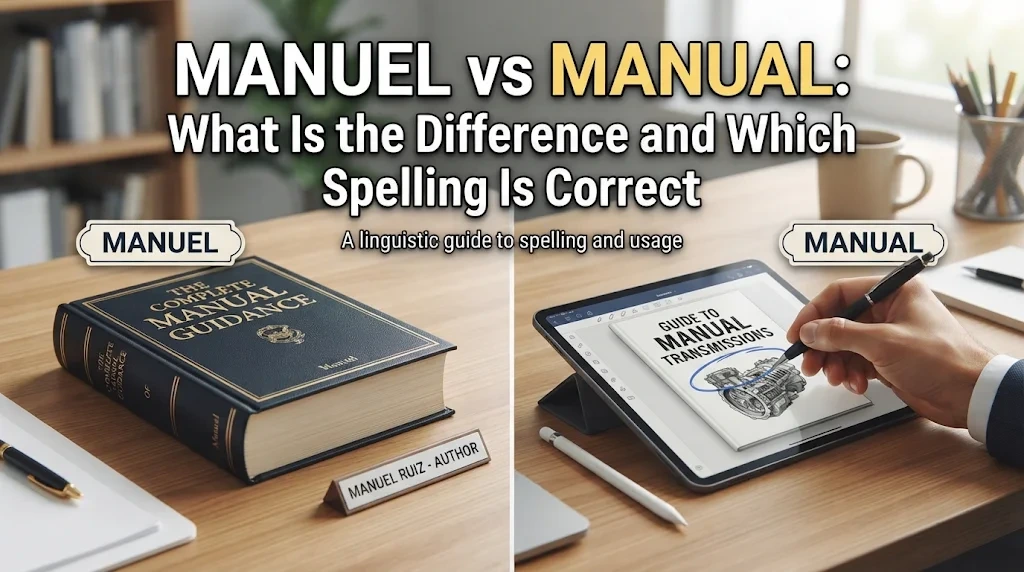
Many English learners get confused when choosing between manuel vs manual because both words look and sound similar. However, they have different meanings and uses. One is generally a proper name, while the other is a common English word used in everyday communication.
The confusion often happens when people write quickly, search for the correct spelling, or hear these words in conversations. Understanding the difference between manuel and manual can help you avoid spelling mistakes and improve your English writing.
In this guide, we will explain the meaning, spelling, pronunciation, sentence structure, and grammatical usage of both words. You will also find practical examples, common mistakes, and answers to frequently asked questions.
2. Manuel vs Manual: Quick Answer
The main difference between Manuel and manual is that Manuel is usually a personal name, whereas manual is an English word that describes something done by hand or a book of instructions.
- Manuel: A masculine given name used in many Spanish- and Portuguese-speaking communities.
- Manual: An adjective meaning done by hand or a noun referring to an instruction book or guide.
Examples:
- Manuel is my new classmate.
- Please read the user manual before operating the machine.
- Manual work requires physical effort.
Therefore, if you are talking about a person’s name, use Manuel. If you mean instructions, physical work, or something operated by hand, use manual.
3. Definition of Manuel
Manuel is a masculine personal name commonly used in Spanish- and Portuguese-speaking countries. It is a traditional name related to the Hebrew name Immanuel, which means “God is with us.”
Unlike ordinary English nouns and adjectives, Manuel is a proper noun. This means it refers to a particular person and must begin with a capital letter.
The name Manuel is used in different cultures and languages. Although its pronunciation can vary slightly depending on the language, it is widely recognized as a personal name.
Examples of Manuel in sentences:
- Manuel is studying English at university.
- My friend Manuel lives in Spain.
- Manuel works as a professional teacher.
- I received a message from Manuel yesterday.
- Manuel is learning how to drive a car.
In these examples, Manuel identifies a particular person rather than describing an activity or object.
4. Definition of Manual
Manual is a common English word that can function as both a noun and an adjective. Its meaning depends on how it is used in a sentence.
As an adjective, manual describes something performed using the hands rather than automatically or electronically.
As a noun, a manual is a book, document, or guide that provides instructions about how to use or operate something.
Examples of manual as an adjective:
- Manual labor can be physically demanding.
- My car has a manual transmission.
- The company uses a manual process.
- Manual work requires physical strength.
Examples of manual as a noun:
- I read the instruction manual.
- The teacher gave us a grammar manual.
- Please check the computer manual.
- This manual explains how the machine works.
Thus, manual has several grammatical uses, making it an important word in everyday English.
5. Manuel vs Manual: Key Differences
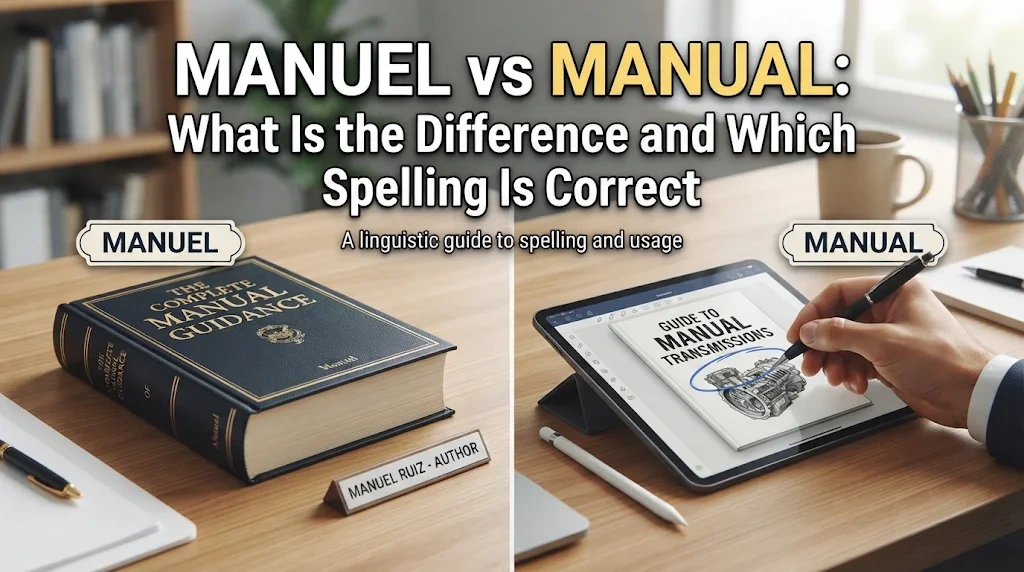
Although Manuel and manual have similar spellings, their grammatical functions and meanings are different.
| Feature | Manuel | Manual |
| Word type | Proper noun | Noun and adjective |
| Meaning | A personal name | Done by hand or an instruction book |
| First letter | Usually capital M | Usually lowercase m |
| Usage | Identifying a person | Describing work, processes, or instructions |
| Example | Manuel is my brother. | I need a user manual. |
| Plural form | Manuels (rare) | Manuals |
| Grammar category | Proper noun | Common noun and adjective |
The easiest way to remember the difference is that Manuel names someone, while manual describes something or provides instructions.
6. Sentence Structure: How to Use Manuel and Manual
Understanding sentence structure makes it easier to use these words correctly. Since they have different grammatical functions, they appear in different positions within sentences.
Using Manuel as a Proper Noun
Manuel generally works as the subject or object of a sentence.
Common sentence patterns:
- Subject + Verb + Object
- Subject + Linking Verb + Complement
Examples:
- Manuel plays football every weekend.
- Manuel speaks English fluently.
- I met Manuel at the shopping center.
- Manuel is a talented musician.
- We invited Manuel to the party.
Using Manual as a Noun
When manual is a noun, it usually refers to an instruction book.
Sentence pattern:
Subject + Verb + Article + Manual
Examples:
- I bought a new manual.
- She opened the instruction manual.
- The manual contains useful information.
- He downloaded the computer manual.
Using Manual as an Adjective
When manual is an adjective, it describes a noun.
Sentence pattern:
Subject + Verb + Manual + Noun
Examples:
- Manual labor is physically challenging.
- He drives a manual car.
- We completed the manual process.
- The machine requires manual operation.
7. Important Grammar Rules for Manuel vs Manual
There are several simple grammar rules that help you distinguish these words.
Rule 1: Capitalize Manuel
Because Manuel is a proper name, always capitalize its first letter when referring to a person.
Correct: Manuel is my best friend.
Incorrect: manuel is my best friend.
Rule 2: Use lowercase manual in ordinary sentences
The word manual is a common noun or adjective, so it normally starts with a lowercase letter unless it appears at the beginning of a sentence or in a title.
Correct: I purchased a new manual.
Incorrect: I purchased a new Manuel.
Rule 3: Use manual for instructions
When discussing guides, handbooks, or documents explaining how something works, use manual.
Example: Read the installation manual carefully.
Rule 4: Use manual for physical activities
When something is performed by hand rather than automatically, manual is the correct word.
Example: The workers perform manual tasks.
Rule 5: Do not confuse names with ordinary vocabulary
A person’s name and an ordinary English word may look similar, but their meanings depend on context.
For example:
- Manuel is operating the machine.
- Manuel operation requires physical effort.
The first sentence identifies a person. The second describes a type of operation.
8. 10 Examples of Manuel and Manual in Sentences
The following examples will help you understand how both words work in everyday English.
Examples of Manuel
- Manuel is my closest friend.
- I met Manuel during my college years.
- Manuel works in a software company.
- My brother Manuel enjoys reading books.
- Manuel is traveling to another country.
- We invited Manuel to our wedding.
- Manuel speaks Spanish and English.
- The teacher asked Manuel a question.
- Manuel completed his homework on time.
- I have known Manuel for several years.
Examples of Manual
- Please read the user manual carefully.
- Manual labor can be difficult.
- My father prefers driving a manual car.
- The workers use manual tools.
- This machine requires manual operation.
- She downloaded the instruction manual.
- Manual work takes more time.
- The company changed its manual process.
- I found the answer in the training manual.
- The technician followed the repair manual.
These examples demonstrate that Manuel identifies a person, while manual describes an activity, process, or instructional document.
Read More;Emaculate vs Immaculate: Meaning, Spelling, Difference, and 10 Examples
9. Common Mistakes When Using Manuel and Manual
English learners sometimes use these words interchangeably because they contain almost the same letters. However, replacing one with the other can change the meaning of a sentence.
Here are some common mistakes and their corrections.
| Incorrect Sentence | Correct Sentence | Explanation |
| I read the Manuel. | I read the manual. | An instruction book is a manual. |
| manuel is my friend. | Manuel is my friend. | Personal names need capital letters. |
| I prefer Manuel work. | I prefer manual work. | Manual describes work done by hand. |
| Please call manual. | Please call Manuel. | A person’s name is Manuel. |
| He bought a Manuel car. | He bought a manual car. | Manual describes the transmission type. |
How to avoid these mistakes:
- Remember that Manuel is a person’s name.
- Use manual when discussing instruction books.
- Use manual as an adjective for activities performed by hand.
- Check capitalization when writing proper nouns.
- Read the complete sentence to understand its intended meaning.
These small grammar habits can improve your spelling accuracy and written communication.
10. Related Words, Adjectives, and Verbs
Learning related vocabulary can help you understand the use of manual in different contexts.
The word manual is commonly associated with physical activities, instructions, equipment, and human effort.
Here are some related words:
| Word | Part of Speech | Meaning |
| Manually | Adverb | By hand or without automation |
| Manual | Noun | An instruction book |
| Manual | Adjective | Done by hand |
| Automation | Noun | The use of technology to perform tasks |
| Automatic | Adjective | Working without direct human control |
| Operate | Verb | To control or use a machine |
| Instruct | Verb | To teach or provide directions |
| Guide | Noun/Verb | Instructions or the act of directing someone |
Examples in sentences:
- The machine must be operated manually.
- The automatic system saves time.
- The technician followed the instructions.
- She learned how to operate the equipment.
- The training manual explains every step.
Manual vs Manually
These words are related but have different grammatical functions.
- Manual is a noun or adjective.
- Manually is an adverb.
Examples:
- Manual work requires effort.
- The workers completed the task manually.
Understanding parts of speech is just as important as learning spelling differences.
11. Manuel vs Manual: Pronunciation and Spelling Differences
Another reason people confuse Manuel and manual is their similar appearance and pronunciation.
However, their pronunciation is not exactly the same in English.
| Word | Common English Pronunciation | Syllables |
| Manuel | man-WEL | 2 |
| Manual | MAN-yoo-uhl | 3 |
Manuel is commonly pronounced as man-WEL in English, although Spanish and Portuguese pronunciations differ.
Manual is commonly pronounced as MAN-yoo-uhl.
Both words contain six letters, but their vowel sounds and syllable patterns are different.
To improve your pronunciation:
- Say Manuel slowly: man-WEL.
- Say manual slowly: MAN-yoo-uhl.
- Listen to examples from an English dictionary.
- Practice both words in complete sentences.
- Pay attention to the different vowel sounds.
Pronunciation practice can help you recognize these words when listening to native English speakers.
12. Manuel vs Manual in Different Tenses and Clauses
Although Manuel is a proper noun and manual is a noun or adjective, both can appear in sentences using different English tenses.
The word itself does not change according to tense. Instead, the verbs around it change.
Present Indefinite Tense
- Manuel works in an office.
- I use a manual for my computer.
Past Indefinite Tense
- Manuel visited my house yesterday.
- I read the manual last night.
Present Continuous Tense
- Manuel is studying English.
- I am reading the instruction manual.
Future Indefinite Tense
- Manuel will visit us tomorrow.
- I will purchase a new manual next week.
These future indefinite tense examples show how both words can be used in future sentences.
Clauses and Grammar Usage
A clause is a group of words containing a subject and a verb. Manuel and manual can appear in independent and dependent clauses.
Independent clause examples:
- Manuel is working.
- The manual is helpful.
Dependent clause examples:
- When Manuel arrives.
- Because the manual is missing.
Combined sentence examples:
- Manuel will help me when he arrives.
- I will repair the machine after reading the manual.
- Although Manuel was tired, he completed the work.
Remember that the use of had, has vs have, and other verb forms depends on the subject and tense, not on whether you use Manuel or manual.
For example:
- Manuel has a new car.
- The manual has useful information.
- Manuel had an old computer.
- The manuals have detailed instructions.
This shows how nouns and proper names work with different verbs and tenses.
13. Frequently Asked Questions About Manuel vs Manual
1. Is Manuel or manual the correct spelling?
Both are correct spellings, but they have different meanings. Manuel is usually a person’s name, while manual means something done by hand or an instruction book.
2. What does Manuel mean?
Manuel is a masculine given name related to the Hebrew name Immanuel, meaning “God is with us.” It is commonly used in Spanish- and Portuguese-speaking communities.
3. What does manual mean in English?
Manual means performed by hand rather than automatically. It can also refer to a book containing instructions about how to use something.
4. Is manual a noun or an adjective?
Manual can be both. As a noun, it means an instruction book. As an adjective, it describes something performed by hand.
5. Is Manuel a proper noun?
Yes. Manuel is a proper noun because it is a personal name. It should always begin with a capital letter when used as a name.
6. What is the difference between manual and manually?
Manual is a noun or adjective, whereas manually is an adverb. For example, manual work describes an activity, while working manually means performing an activity by hand.
7. What is the plural of manual?
The plural form of manual is manuals. For example, the library contains several instruction manuals.
8. Can Manuel and manual be used in the same sentence?
Yes. Both words can appear in one sentence when their meanings are clear.
Example: Manuel read the manual before operating the machine.
Conclusion
Understanding Manuel vs Manual is simple once you learn their meanings and grammatical functions. Although these words look similar, they are not interchangeable.
Manuel is generally a masculine personal name used to identify someone. On the other hand, manual is an English noun or adjective that refers to instruction books, physical work, or activities performed by hand.
Remember to capitalize Manuel when referring to a person and use lowercase manual for ordinary writing. By learning their definitions, sentence structures, pronunciation, and examples, you can avoid common spelling mistakes and improve your English grammar.
The easiest rule to remember is: Manuel is a name, while manual means done by hand or an instruction book.

[…] Read More;Manuel vs Manual: What Is the Difference and Which Spelling Is Correct? […]