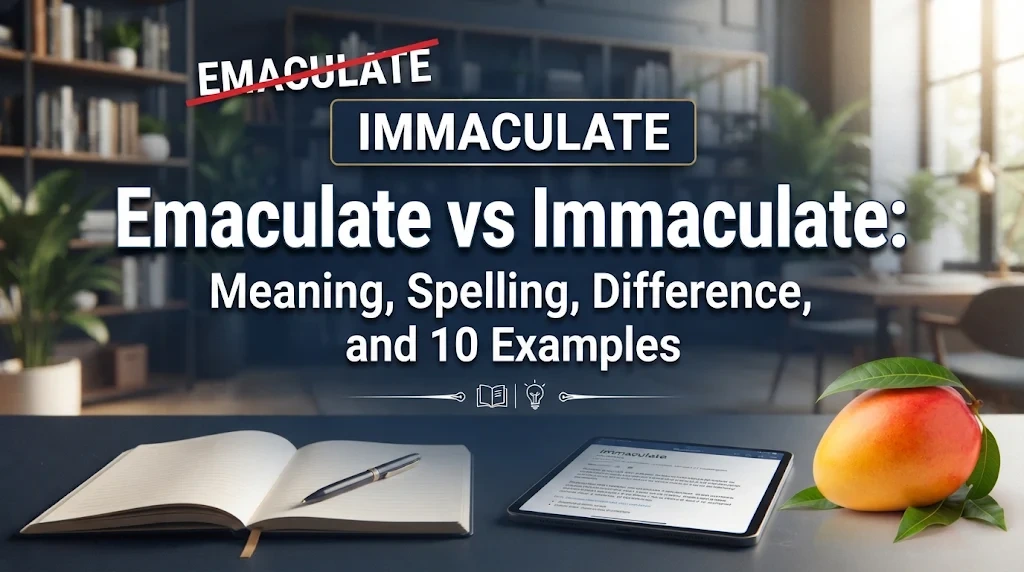
English spelling can sometimes be confusing, especially when two words look almost identical but only one is correct. Emaculate vs Immaculate is a good example of this confusion. Many English learners mistakenly write emaculate when they actually mean immaculate. Although these words look similar, they do not have the same spelling status.
The correct English word is immaculate, which means perfectly clean, neat, spotless, or free from mistakes. On the other hand, emaculate is an incorrect spelling and is not recognized as a standard English word.
Understanding the difference between emaculate and immaculate can help you improve your spelling, vocabulary, writing skills, and overall English grammar. In this guide, we will explain their meanings, sentence structures, grammatical rules, examples, and common mistakes in simple English.
2. Emaculate vs Immaculate: Quick Difference
The main difference between emaculate vs immaculate is that immaculate is the correct spelling, while emaculate is a common spelling mistake.
Immaculate is an adjective used to describe something that is perfectly clean, organized, or without errors. It can describe a person’s appearance, a room, clothing, work, or behavior.
For example:
- Her bedroom looks immaculate.
- He wore an immaculate white suit.
- The student submitted an immaculate assignment.
However, writing emaculate instead of immaculate is a spelling error. If you want to describe something as spotless or flawless, always use immaculate.
3. Definition of Immaculate
The word immaculate is an adjective that means completely clean, perfectly neat, or free from any mistakes or imperfections.
It is commonly used in everyday English, formal writing, professional communication, and descriptions.
Here are the main meanings:
- Spotlessly clean: Something that has no dirt, stains, or marks.
- Perfectly neat: Something that is carefully organized and maintained.
- Flawless: Something that has no mistakes or visible imperfections.
- Excellent condition: Something that looks almost new or perfectly maintained.
For example, if someone says, “Your kitchen is immaculate,” they mean that the kitchen is extremely clean and organized.
Similarly, an immaculate performance means a performance completed without noticeable mistakes.
4. Is Emaculate a Correct Word?
No, emaculate is not a standard English word. It is generally considered a misspelling of immaculate.
English learners sometimes make this mistake because the pronunciation and spelling of immaculate can be confusing. They may leave out one letter or replace the first two letters with an incorrect combination.
Remember these spellings:
- Incorrect: Emaculate
- Correct: Immaculate
For example:
- Incorrect: Her house is emaculate.
- Correct: Her house is immaculate.
Therefore, whenever you want to describe something as perfectly clean, neat, or flawless, use immaculate.
5. Sentence Structure and Use of Immaculate
Understanding sentence structure makes it easier to use adjectives correctly. Since immaculate is an adjective, it usually describes a noun.
It can appear before a noun or after a linking verb such as is, are, was, and looks.
Common sentence patterns:
| Sentence structure | Example |
| Adjective + Noun | She has an immaculate house. |
| Subject + Is + Adjective | The room is immaculate. |
| Subject + Looks + Adjective | Your office looks immaculate. |
| Subject + Kept + Object + Adjective | They kept the garden immaculate. |
The adjective can also be used with other descriptive words to make sentences more meaningful.
For example:
- The hotel has an exceptionally immaculate interior.
- Her presentation was absolutely immaculate.
- They maintain a beautifully immaculate garden.
These sentence patterns help learners understand the correct use of adjectives in English.
6. Grammar Rules for Using Immaculate
There are several simple grammar rules to remember when using immaculate in sentences.
Rule 1: Use immaculate before a noun.
When an adjective comes before a noun, it describes that noun.
Examples:
- He lives in an immaculate apartment.
- She bought an immaculate dress.
- We visited an immaculate hotel.
Rule 2: Use immaculate after linking verbs.
You can use immaculate after verbs such as is, was, looks, and seems.
Examples:
- The kitchen is immaculate.
- His appearance looks immaculate.
- The classroom was immaculate.
Read More;Click vs Clique: Meaning, Differences, Examples, and How to Use Them Correctly
Rule 3: Use an before immaculate.
When immaculate is used with a singular countable noun, it generally takes the article an because its first sound is a vowel sound.
Examples:
- She owns an immaculate car.
- He lives in an immaculate house.
- It was an immaculate performance.
Rule 4: Do not change its spelling.
The correct spelling remains immaculate whether you use it in the present, past, or future tense.
7. Immaculate Examples: 10 Sentences
Learning through examples is one of the easiest ways to understand new vocabulary. Here are 10 examples of immaculate used in everyday English.
- Her bedroom is always immaculate and organized.
- He wore an immaculate black suit to the wedding.
- The hotel staff kept every room immaculate.
- She delivered an immaculate presentation at the meeting.
- My mother keeps the kitchen immaculate.
- The teacher praised his immaculate handwriting.
- They purchased an immaculate secondhand car.
- His garden looks immaculate throughout the year.
- The chef maintained an immaculate working environment.
- Her performance in the competition was immaculate.
These sentences show that immaculate can describe physical cleanliness as well as excellent quality and performance.
8. Common Mistakes When Writing Emaculate and Immaculate
Many students make spelling mistakes when writing words that contain repeated letters or unfamiliar combinations. The confusion between emaculate and immaculate usually happens because learners do not remember the correct spelling.
Here are some common mistakes and their corrections.
| Incorrect sentence | Correct sentence |
| Her room is emaculate. | Her room is immaculate. |
| He has an emaculate car. | He has an immaculate car. |
| The kitchen looks emaculate. | The kitchen looks immaculate. |
| She gave an emaculate performance. | She gave an immaculate performance. |
| His handwriting is emaculate. | His handwriting is immaculate. |
How to avoid these mistakes:
- Memorize the correct spelling: immaculate.
- Remember that it begins with imm, not em.
- Read English books and articles regularly.
- Practice writing the word in different sentence structures.
- Use a spellchecker when editing important documents.
These small habits can improve your spelling accuracy and English writing skills.
9. Comparison Table: Emaculate vs Immaculate
A comparison table makes it easier to understand the spelling difference between these two forms.
| Feature | Emaculate | Immaculate |
| Spelling status | Incorrect | Correct |
| English usage | Nonstandard | Standard |
| Part of speech | Not recognized as a standard word | Adjective |
| Meaning | No established standard meaning | Perfectly clean or flawless |
| Dictionary usage | Not a standard dictionary entry | Recognized English word |
| Example | Emaculate room | Immaculate room |
| Recommended use | Avoid | Use |
As the table shows, immaculate is the only correct standard spelling when describing something as spotless or flawless.
10. Related Verbs and Adjectives
Although immaculate is an adjective, several related words can help you express similar ideas in English.
Understanding adjectives and verbs will also improve your vocabulary and sentence formation.
| Word | Part of speech | Meaning |
| Immaculate | Adjective | Perfectly clean or flawless |
| Clean | Adjective/Verb | Free from dirt or remove dirt |
| Polish | Verb | Make something smooth or shiny |
| Maintain | Verb | Keep something in good condition |
| Organize | Verb | Arrange things properly |
| Spotless | Adjective | Completely clean |
| Flawless | Adjective | Without mistakes or defects |
| Pristine | Adjective | In perfect or original condition |
Example sentences:
- She carefully polished her shoes.
- They maintain their office every day.
- He keeps his workspace spotless.
- The manager organized the entire department.
- The building looks pristine after renovation.
These related verbs and adjectives help you describe cleanliness, organization, and perfection more naturally.
11. Immaculate in Different English Tenses
The word immaculate does not change its spelling according to English tenses because it is an adjective, not a verb.
However, you can use it with different tenses by changing the main verb in the sentence.
| Tense | Example |
| Present Simple | Her house is immaculate. |
| Past Simple | Her house was immaculate. |
| Future Simple | Her house will be immaculate. |
| Present Continuous | Her house is looking immaculate. |
| Past Continuous | Her house was looking immaculate. |
| Present Perfect | Her house has remained immaculate. |
| Past Perfect | Her house had remained immaculate. |
| Future Perfect | Her house will have remained immaculate. |
Notice that the adjective immaculate stays the same in every sentence.
This is also a useful way to understand the use of had, has vs have, and future indefinite tense examples.
For instance:
- Has: She has an immaculate kitchen.
- Have: They have an immaculate kitchen.
- Had: They had an immaculate kitchen.
- Future: They will have an immaculate kitchen.
The helping verbs change according to the subject and tense, but the adjective remains unchanged.
12. Immaculate in Clauses and Different Sentence Patterns
You can use immaculate in different types of clauses to make your English sentences more descriptive.
A clause is a group of words containing a subject and a verb. It can be independent or dependent.
Independent clause:
An independent clause expresses a complete thought.
Example:
– The room is immaculate.
Dependent clause:
A dependent clause does not express a complete thought by itself.
Example:
– Because the room is immaculate.
Complex sentence:
You can combine an independent clause with a dependent clause.
Examples:
- Everyone admired the house because it was immaculate.
- Although the hotel was old, its rooms were immaculate.
- She received compliments because her appearance was immaculate.
Compound sentence:
You can also connect two independent clauses using conjunctions.
Example:
– The house was old, but its interior was immaculate.
These sentence patterns help you use adjectives naturally while improving your understanding of clauses and English grammar.
13. FAQs About Emaculate vs Immaculate
1. Is emaculate a real English word?
No, emaculate is not a standard English word. It is usually a misspelling of immaculate.
2. What is the correct spelling: emaculate or immaculate?
The correct spelling is immaculate. It begins with the letters “imm” rather than “em.”
3. What does immaculate mean?
Immaculate means perfectly clean, neat, spotless, or free from mistakes and imperfections.
4. Is immaculate an adjective?
Yes, immaculate is an adjective. It describes a noun by showing that something is perfectly clean or flawless.
5. How do you use immaculate in a sentence?
You can use immaculate before a noun or after a linking verb.
Example: Her bedroom is immaculate.
6. What is another word for immaculate?
Some common synonyms include spotless, pristine, flawless, perfect, clean, and impeccable. However, their meanings can vary slightly depending on the context.
7. What is the opposite of immaculate?
Common opposites include dirty, messy, untidy, stained, imperfect, and flawed.
8. Is immaculate used in American and British English?
Yes. Immaculate is the correct spelling in both American and British English. There is no regional spelling difference.
Conclusion
Understanding emaculate vs immaculate is simple once you remember which spelling is correct. Immaculate is the standard English adjective that means perfectly clean, spotless, neat, or flawless. In contrast, emaculate is an incorrect spelling that should be avoided in formal and informal writing.
You can use immaculate to describe a clean room, beautiful appearance, organized workplace, excellent performance, or something without mistakes. It works naturally with different verbs, sentence structures, and tenses without changing its spelling.
To improve your English vocabulary and avoid spelling errors, practice using immaculate in everyday sentences. Remember one simple rule: always write immaculate, never emaculate.

[…] Read More;Emaculate vs Immaculate: Meaning, Spelling, Difference, and 10 Examples […]