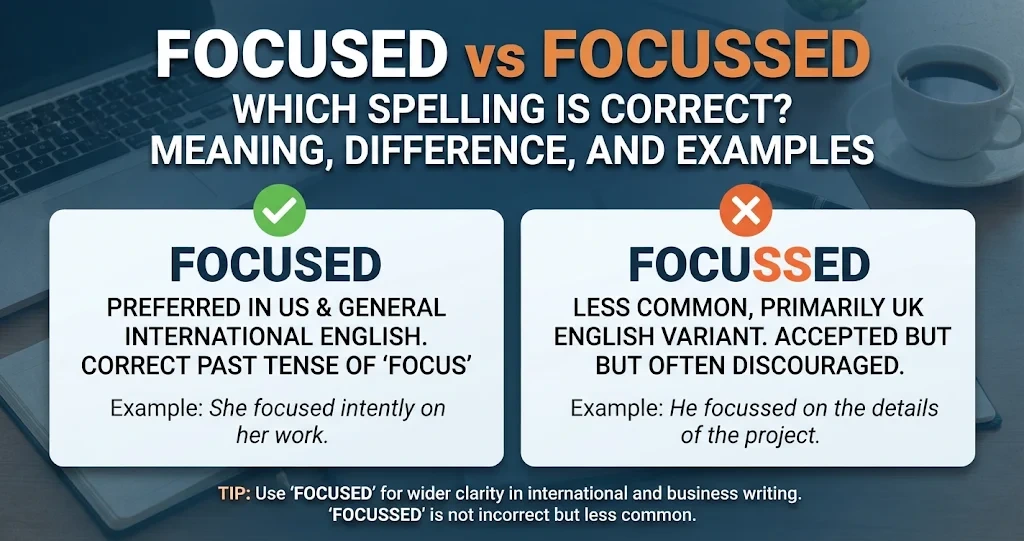
Have you ever wondered whether to write focussed or focused? Both spellings look correct, and you may have seen them used in books, websites, articles, and everyday conversations. However, the correct choice often depends on the type of English you are using.
The good news is that focussed and focused are both correct spellings of the past tense and past participle of the verb focus. The main difference is regional spelling preference. Focused is more common in American English, while focussed is traditionally preferred in British English, although focused is also widely accepted in British writing.
Understanding the difference between these two words can improve your English spelling, grammar, and writing skills. In this article, we will explain their meanings, grammatical rules, sentence structures, and practical examples.
1. Focussed vs Focused: Quick Difference
The main difference between focussed vs focused is the spelling style rather than the meaning. Both words describe concentrating attention, effort, or interest on something.
- Focused: The standard and more common spelling in American English.
- Focussed: A traditional alternative spelling, particularly associated with British English.
Both words are grammatically correct and have the same pronunciation and meaning.
For example:
- She focused on her studies before the examination.
- She focussed on her studies before the examination.
Both sentences are correct. However, the first spelling is more common in American English, while the second follows a traditional British spelling preference.
2. Definition of Focused and Focussed
To understand these words properly, it is important to look at their meaning and grammatical function.
What Does Focused Mean?
Focused is the past tense and past participle of the verb focus. It means to direct your attention, thoughts, energy, or efforts toward a particular activity, person, or subject.
It can also work as an adjective to describe someone who is concentrating or something that has a clear purpose.
Examples:
- He focused on completing his homework.
- The teacher focused on improving students’ writing skills.
- She is a focused and hardworking student.
What Does Focussed Mean?
Focussed has exactly the same meaning as focused. It is an alternative spelling that doubles the final consonant before adding the suffix -ed.
Examples:
- The manager focussed on the company’s main goals.
- I remained focussed during the entire examination.
- They focussed their attention on the important details.
Therefore, neither spelling represents a different meaning or grammatical tense.
3. Sentence Structure of Focused vs Focussed
Both focused and focussed follow the same sentence structure because they are different spellings of the same verb form.
You can use them in several grammatical patterns.
| Sentence structure | Example |
| Subject + focused + on + noun | She focused on her career. |
| Subject + focused + on + verb-ing | He focused on learning English. |
| Subject + had + focused | They had focused on the project. |
| Subject + has/have + focused | She has focused on her studies. |
| Subject + was/were + focused | The team was focused on winning. |
The same structures work with focussed.
For example:
- She focussed on her career.
- He had focussed on learning English.
- They have focussed on their goals.
Remember that the word following focused on is usually a noun, pronoun, or gerund (verb ending in -ing).
4. Grammar Rules for Using Focused and Focussed
Although both spellings are correct, there is a simple spelling rule behind their differences.
Rule 1: The American English Spelling
In American English, the verb focus usually takes the suffix -ed without doubling the final consonant.
- Focus → Focused
- Focus → Focusing
- Focus → Focuses
Examples:
- I focused on my work.
- She is focusing on her education.
- He focuses on improving his skills.
Rule 2: The Traditional British English Spelling
In traditional British English, the final consonant is often doubled before adding a suffix beginning with a vowel.
- Focus → Focussed
- Focus → Focussing
- Focus → Focusses
Examples:
- I focussed on my work.
- She is focussing on her education.
- He focusses on improving his skills.
However, modern British English also commonly uses focused and focusing. Therefore, the single-s spelling is not exclusively American.
Rule 3: Maintain Consistency
Choose one spelling style and use it consistently throughout your writing.
For example, if you are following American English, use:
- Focused
- Focusing
- Focuses
If you prefer the traditional British spelling, use:
- Focussed
- Focussing
- Focusses
Consistency makes your writing look professional and easier to read.
5. 10 Examples of Focused and Focussed in Sentences
The following examples show how both spellings work in everyday English. You can use these sentences to understand their meanings and improve your grammar.
- She focused on her studies to achieve better grades.
- He remained focussed during the important business meeting.
- The teacher focused on explaining difficult grammar rules.
- I have focussed all my attention on learning English.
- They focused their efforts on completing the project.
- The company remained focussed on customer satisfaction.
- She has focused on improving her communication skills.
- The students focussed on preparing for their final examinations.
- We had focused on the wrong details during the discussion.
- He is a highly focused person who works hard to achieve his goals.
All ten examples are grammatically correct. You can replace focused with focussed without changing the meaning.
6. Focussed vs Focused: Comparison Table
A comparison table makes it easier to understand the similarities and differences between these spellings.
| Feature | Focused | Focussed |
| Meaning | Concentrated attention | Concentrated attention |
| Grammar | Past tense and past participle | Past tense and past participle |
| American English | Preferred | Less common |
| British English | Widely accepted | Traditional alternative |
| Pronunciation | Same | Same |
| Spelling | One S before -ed | Two S letters before -ed |
| Correctness | Correct | Correct |
| Usage | More common internationally | Less common internationally |
The important point is that focused is the more widely used spelling, but focussed is not a spelling mistake.
7. Verb Forms and Related Words of Focus
The verb focus has different forms depending on the sentence, subject, and tense. Understanding these forms will help you use focused and focussed correctly.
| Verb form | American spelling | Traditional British alternative |
| Base form | Focus | Focus |
| Third-person singular | Focuses | Focusses |
| Present participle | Focusing | Focussing |
| Past tense | Focused | Focussed |
| Past participle | Focused | Focussed |
Here are some additional examples:
- Focus: I need to focus on my work.
- Focuses: She focuses on her personal development.
- Focusing: He is focusing on his studies.
- Focused: They focused on their future.
- Focussed: She remained focussed on her goals.
These are examples of different verbs and verb forms connected with the same root word.
8. Focused vs Focussed in Different English Tenses
Both spellings can be used in different tenses because they represent the same past tense and past participle forms.
Let’s understand their use through common English tenses.
Simple Past Tense
Use focused or focussed to describe an action completed in the past.
- She focused on her examination.
- She focussed on her examination.
Present Perfect Tense
Use has or have followed by the past participle.
- He has focused on his career.
- He has focussed on his career.
Past Perfect Tense
Use had followed by the past participle.
- They had focused on their main objectives.
- They had focussed on their main objectives.
This is also a useful example of the use of had in English grammar.
Future Indefinite Tense
Use will followed by the base form of the verb.
- She will focus on her education.
- They will focus on their business goals.
Notice that future indefinite tense examples use focus, not focused or focussed, after will.
Understanding these patterns also helps when studying topics such as has vs have, present perfect tense, and past perfect tense.
9. Common Mistakes When Using Focused and Focussed
English learners sometimes become confused when they see two spellings of the same word. Here are some common mistakes and their corrections.
Mistake 1: Thinking focussed is always incorrect.
Incorrect understanding: Focussed is never a correct English word.
Correct understanding: Focussed is a valid alternative spelling, particularly in traditional British English.
Read More;Manuel vs Manual: What Is the Difference and Which Spelling Is Correct?
Mistake 2: Thinking both words have different meanings.
Incorrect understanding: Focused means paying attention, while focussed means concentrating deeply.
Correct understanding: Both words have exactly the same meaning.
Mistake 3: Mixing spelling styles.
Example:
- She is focused on her studies.
- He is focussing on his career.
These sentences are individually correct, but mixing spelling conventions in one formal document may look inconsistent.
Mistake 4: Using the past form after will.
Incorrect: She will focused on her work.
Correct: She will focus on her work.
Remember that modal verbs such as will are followed by the base form of the main verb.
10. Focused vs Focussed in American and British English
English spelling varies between countries. Some words have different accepted spellings in American and British English, such as color and colour, organize and organise, and traveled and travelled.
The same spelling variation appears with focused and focussed.
American English
American English generally prefers focused, with one s before the -ed suffix.
Examples:
- The student focused on the lesson.
- She is focusing on her career.
- The team remained focused.
British English
Traditional British English often uses focussed, with two s letters before the -ed suffix.
Examples:
- The student focussed on the lesson.
- She is focussing on her career.
- The team remained focussed.
However, British dictionaries and publications also commonly accept the single-s forms.
If you are writing for an American audience, choose focused. For traditional British spelling, focussed is an option. For general international writing, focused is a practical choice.
11. Adjective Usage, Clauses, and Related Grammar
The word focused can function as both a verb form and an adjective. Its grammatical role depends on how it is used in a sentence.
Focused as an Adjective
When focused describes a person, activity, or object, it functions as an adjective.
Examples:
- She is a focused student.
- He has a focused approach to business.
- The meeting was focused and productive.
Focused as a Verb
When focused describes an action performed by the subject, it functions as a verb.
Examples:
- She focused on her studies.
- The company focused on customer service.
- We focused our attention on the problem.
Focused in Clauses
A clause contains a subject and a verb. You can use focused in independent and dependent clauses.
Examples:
- Independent clause: She focused on her work.
- Dependent clause: Because she focused on her work, she completed the project.
- Combined sentence: Although the task was difficult, he remained focused.
Understanding clauses, adjectives, verbs, and sentence patterns makes it easier to use both spellings naturally.
12. FAQs About Focussed vs Focused
Here are some frequently asked questions about focused and focussed to help beginners understand the correct spelling.
1. Is focused or focussed correct?
Both focused and focussed are correct English spellings. Focused is more common in American English and widely accepted in British English, while focussed is a traditional British alternative.
2. Is focussed British or American English?
Focussed is traditionally associated with British English. However, modern British English also frequently uses focused.
3. Why does focused have one S?
In American English, the final consonant of focus is generally not doubled before adding the suffix -ed. Therefore, the spelling becomes focused.
4. Does focussed mean the same as focused?
Yes. Both words have exactly the same meaning. They describe concentrating attention, energy, or effort on something.
5. Which spelling should I use in academic writing?
Use focused unless your university, teacher, publisher, or style guide specifically requires the traditional British spelling focussed. The most important thing is to remain consistent.
6. Is focusing or focussing correct?
Both are correct. Focusing is more common in American English and modern international usage, while focussing is a traditional British alternative.
7. What is the past tense of focus?
The past tense of focus is focused or focussed. Both forms are correct and have the same meaning.
8. Can focused be used as an adjective?
Yes. Focused can describe someone who pays close attention to a particular task or goal. For example: “She is a focused student.”
13. Conclusion: Which Spelling Should You Choose?
The difference between focussed vs focused is mainly related to regional spelling preferences, not meaning or grammar. Both words are correct forms of the verb focus and can be used as past tense, past participle, or adjectives.
However, focused is the more common spelling in American English and is also widely accepted in modern British English. On the other hand, focussed remains a traditional British spelling.
If you are unsure which spelling to choose, use focused because it is widely recognized and accepted internationally. Most importantly, maintain consistency throughout your writing.
Understanding this small spelling difference will help you improve your English vocabulary, grammar, and overall writing confidence.

[…] Read More;Focussed vs Focused: Which Spelling Is Correct? Meaning, Difference, and Examples […]