
The Kindergarten vs Kindergarden spelling question confuses learners, but only kindergarten is correct in standard English, in daily writing. Dictionaries and schools recognize kindergarten as the correct spelling of an educational class for young children before primary education. It is connected to early
childhood education, preschool, and nursery school, although their meanings can differ across countries. For English learners, understanding these commonly confused words improves language learning, grammar, vocabulary, and English vocabulary. The German language explains the word
origins, as the original German term means children’s garden. Using the correct form and understanding its spelling difference helps avoid spelling mistakes and improves correct word usage.Good proofreading and spelling correction habits can strengthen writing skills and writing accuracy. Whether
you prepare assignments, articles, emails, applications, or published content, correct spelling makes your work clearer and supports professional communication and professional writing. The same rule applies to
schoolwork, informal writing, everyday conversations, online searches, and messages. Learning the language history behind a word also makes accurate English easier to understand and helps prevent future spelling confusion.
Kindergarten vs Kindergarden: Definition
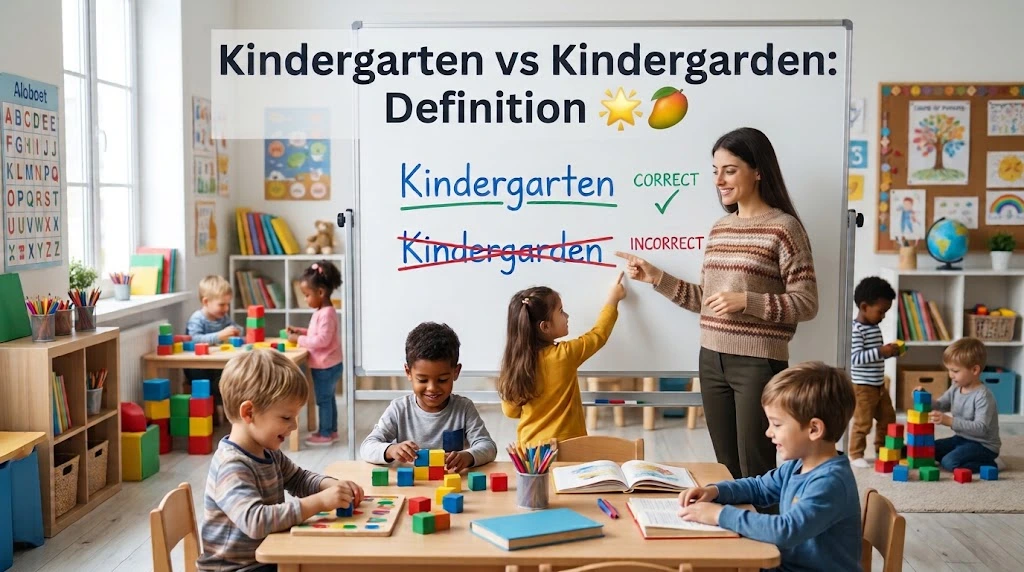
Kindergarten is the correct spelling. It is a noun used for a class, school, or educational stage for young children.
Kindergarden is not the standard English spelling. It is usually created because learners hear the final part of kindergarten and connect it with the familiar word garden.
The word kindergarten comes from German. It literally means “children’s garden.” The German term was introduced by Friedrich Fröbel for an educational setting designed for young children.
Quick Answer
Kindergarten = correct standard spelling
Kindergarden = common misspelling
For formal writing, school documents, educational websites, assignments, and professional communication, always use kindergarten.
Read More;Receive vs Recieve: Which Spelling Is Correct
Sentence Structure With Kindergarten
Because kindergarten is a noun, it can perform different roles in an English sentence. It can be the subject, object, or part of a prepositional phrase.
The basic sentence structure can be:
Subject + verb + kindergarten
For example:
- My daughter attends kindergarten.
- The teacher works at a kindergarten.
- Our son starts kindergarten next year.
You can also use kindergarten with prepositions:
- The children are in kindergarten.
- She teaches at a kindergarten.
- He is ready for kindergarten.
Understanding this sentence structure makes it easier to use the word correctly in everyday English.
Rules for Using Kindergarten Correctly
There are several simple rules to remember when using kindergarten.
- Use kindergarten as the standard spelling.
Do not replace the second t with d. - Remember the ending: -garten.
The correct word is spelled kindergarten, not kindergarden. - Use it as a noun.
For example: “The child is in kindergarten.” - Use lowercase kindergarten when it is used as a general noun.
- Correct: My child starts kindergarten in September.
- Correct: She teaches at a kindergarten.
- Use a capital letter when it begins a sentence or forms part of a proper name.
A useful spelling trick is to remember that kindergarten contains garten, which comes from the German word for garden. However, in English, the standard spelling remains kindergarten.
Kindergarten Examples in Everyday English
Here are several natural examples showing how kindergarten is used.
- My son will start kindergarten this fall.
- She teaches children in kindergarten.
- The kindergarten teacher welcomed the new students.
- We visited the school before our daughter entered kindergarten.
- He made many friends in kindergarten.
- The children learned basic numbers in kindergarten.
- Her younger brother is still in kindergarten.
- The school has three kindergarten classes.
- Kindergarten helps children prepare for formal schooling.
- My niece enjoys going to kindergarten every morning.
Kindergarten in Different Sentence Patterns
Present tense:
- She attends kindergarten every day.
Past tense:
- She attended kindergarten last year.
Future tense:
- She will attend kindergarten next year.
These examples also show how nouns work with different tenses and verbs.
Common Mistakes With Kindergarten
The biggest mistake is writing kindergarden instead of kindergarten.
Incorrect:
- My child goes to kindergarden.
- She is a kindergarden teacher.
Correct:
- My child goes to kindergarten.
- She is a kindergarten teacher.
Another common mistake is assuming that kindergarden must be correct because the word sounds similar to garden. English spelling does not always follow pronunciation perfectly.
Learners may also confuse kindergarten with related educational terms such as preschool, nursery, and elementary school. These terms can refer to different stages depending on the country and education system.
Kindergarten vs Kindergarden Comparison Table
| Feature | Kindergarten | Kindergarden |
| Spelling | Correct | Incorrect in standard English |
| Word type | Noun | Misspelling |
| Meaning | Early education for young children | Usually intended to mean kindergarten |
| Standard dictionaries | Listed | Generally not listed as the standard form |
| Formal writing | Recommended | Avoid |
| Example | She is in kindergarten. | She is in kindergarden. |
The key difference is the spelling of the final part. Kindergarten ends in -garten, while the incorrect form kindergarden uses -garden.
Verb Usage With Kindergarten
Since kindergarten is a noun, it commonly appears after verbs related to education, attendance, learning, and teaching.
Common verbs include:
- attend kindergarten
- start kindergarten
- enter kindergarten
- teach kindergarten
- learn in kindergarten
- begin kindergarten
- finish kindergarten
- go to kindergarten
For example:
My daughter starts kindergarten next month.
The teacher teaches kindergarten students.
He learned how to read simple words in kindergarten.
The correct choice of verbs depends on what you want to say. The noun itself does not change when the verb changes.
Kindergarten and English Tenses
The word kindergarten can be used with all major English tenses. The verb changes according to the time, while kindergarten remains the same.
| Tense | Example |
| Present Simple | She attends kindergarten. |
| Past Simple | She attended kindergarten. |
| Future Simple | She will attend kindergarten. |
| Present Continuous | She is attending kindergarten. |
| Past Continuous | She was attending kindergarten. |
| Present Perfect | She has attended kindergarten. |
| Past Perfect | She had attended kindergarten. |
This is also a useful way to understand the use of had, has vs have, and other auxiliary verbs. For example, “She has attended kindergarten” describes an experience connected with the present, while “She had attended kindergarten” places that experience before another past event.
Similarly, when studying future indefinite tense examples, you may see sentences such as:
- She will start kindergarten next year.
- They will attend kindergarten in September.
Clauses and Grammar Usage
Kindergarten can also appear in sentences containing different types of clauses.
For example:
I was happy when my daughter started kindergarten.
The first part is the main clause, while when my daughter started kindergarten is a dependent clause.
Another example is:
The teacher said that the children were ready for kindergarten.
Here, that the children were ready for kindergarten functions as a dependent clause.
You can also use relative clauses:
The kindergarten where my son studies is close to our home.
Learning how clauses, conjunctions, verbs, and sentence structure work together can help students build longer and more natural English sentences.
Related Words and Useful Grammar Terms
Learning kindergarten is also an opportunity to understand several related educational words.
- Preschool — education before formal school
- Nursery — an early-childhood education or care setting in some countries
- Elementary school — primary-level education, especially in the United States
- Teacher — a person who teaches students
- Student — a person who is learning
- Classroom — a room where students learn
- Education — the process of learning and teaching
- School — an institution where people receive education
These words can be used with different verbs, tenses, and clauses to create complete sentences.
For example:
The kindergarten teacher helps young students develop basic reading and social skills.
This type of vocabulary is useful for students learning English grammar and educational terminology. It also demonstrates why understanding nouns, verbs, adjectives, and sentence patterns is important. When studying broader grammar topics such as 10 examples of adjective, learners should remember that adjectives describe nouns, while kindergarten itself functions primarily as a noun.
Conclusion
In conclusion, Kindergarten is the correct spelling in standard English, while Kindergarden is a common spelling mistake. The word comes from the German term meaning “children’s garden,” which explains its unusual ending. Although both spellings may sound similar, only kindergarten is accepted in standard dictionaries and formal writing. Remembering the correct spelling can improve your grammar, vocabulary, and writing accuracy. Whether you are writing school assignments, emails, articles, or professional documents, always use kindergarten.
FAQs
1. Is it Kindergarten or Kindergarden?
Kindergarten is the correct spelling. Kindergarden is a common misspelling.
2. Why do people spell Kindergarten as Kindergarden?
People often write Kindergarden because they confuse the word’s pronunciation with its spelling. The German origin of the word also explains its unusual ending.
3. What does Kindergarten mean?
A kindergarten is an educational class or school for young children, usually before primary school.
4. Is Kindergarten a German word?
Yes. Kindergarten comes from German and literally means “children’s garden.”
5. How can I remember the correct spelling of Kindergarten?
Remember that the word ends in -garten, not -garden. You can also use a dictionary or spell-checking tool to avoid this mistake.
6. Is Kindergarden accepted in standard English?
No. Kindergarden is considered a misspelling. Always use kindergarten in formal and informal writing.


